
A Visit to St Andrews: Studying the St Andrews Qur’an and Persian Manuscript Provenance
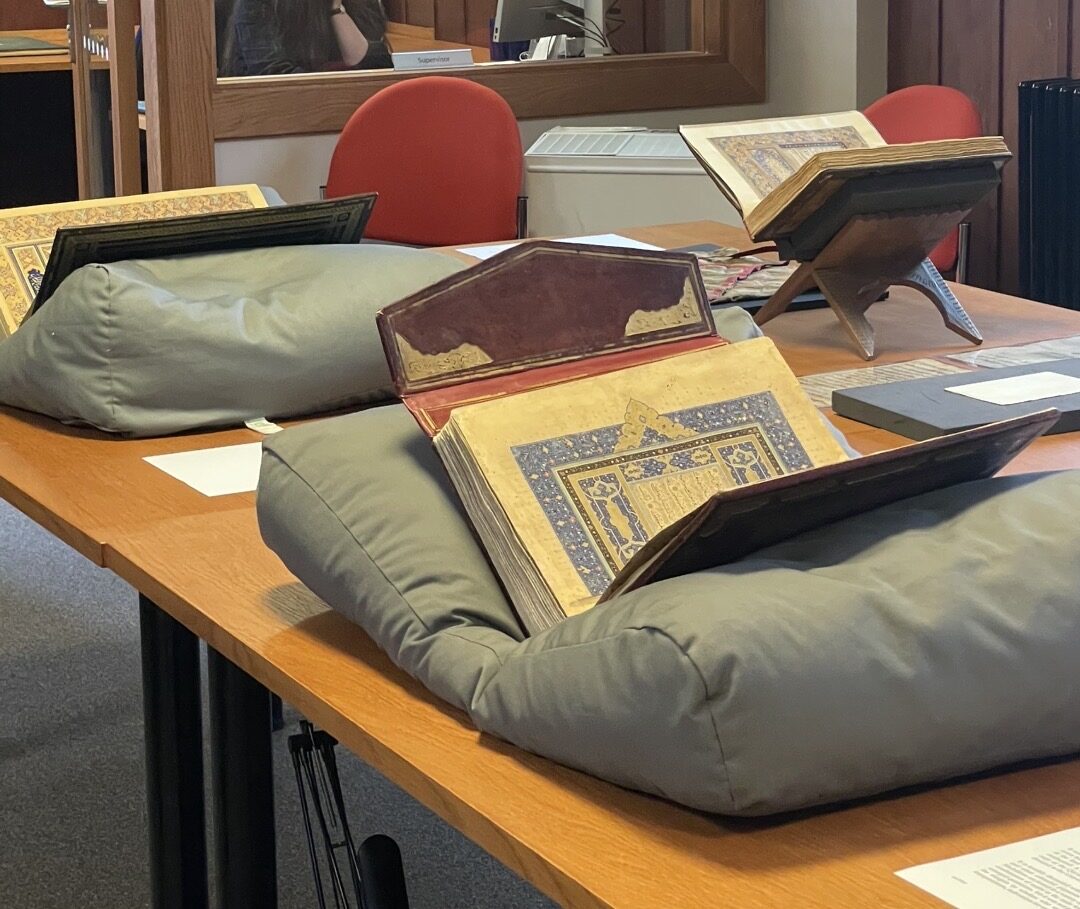
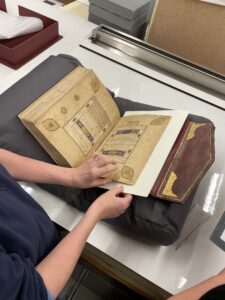
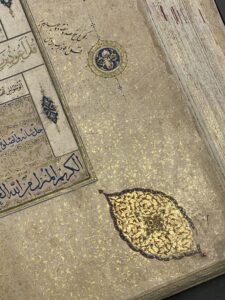
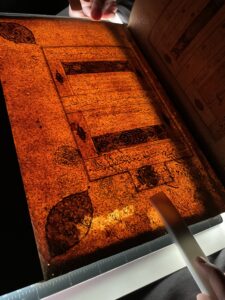
In early November, Theresa travelled to St Andrews for a short but fruitful research visit. At first, she spend some time at the university’s conservation lab, where she had the opportunity to study the famous St Andrews Qur’an. Using a light sheet, she examined the first and last folios of the manuscript and discovered new notes and seals that had not been visible before. For the other folios, with their dense gold-sprinkled margins, she looked closely at the manner of decoration and the overall page layout. Thanks to the excellent facilities, she was able to use her own equipment for close documentation and analysis.
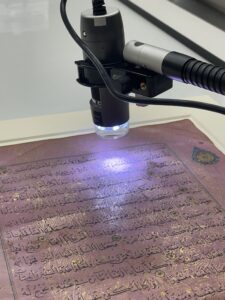
During her stay, Theresa also examined three folios of Chinese paper from a dispersed Qur’an, currently on loan to St Andrews Special Collections from the Sarikhani Collection. We would like to extend our warm thanks to Erica Kotze and Maia Sheridan for making this visit possible and for their generous support and hospitality at the conservation lab.
One day of the visit was dedicated to the workshop “The Provenance and Collection of Persian Manuscripts in the UK”, convened by Dr Andrew Peacock and Ursula Sims-Williams. The workshop explored a wide range of topics, including British manuscript collectors from the eighteenth to the twentieth century, the formation and dispersal of collections, the role of indigenous collectors, and the presence of Persian manuscripts in British institutions.
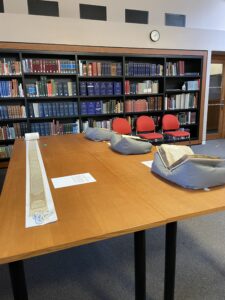
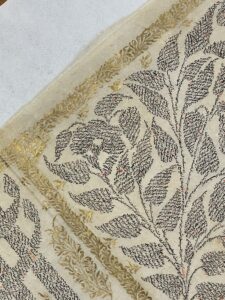
Before lunch, participants visited St Andrews Special Collections to view several remarkable objects, among them the “St Andrews Qur’an” and a “Bustan” with a dedication to King George III — an exquisite scroll featuring miniature script arranged in the shapes of leaves and flowers. Theresa was happy to see these wonderful manuscripts again after completing her master’s degree there some years ago. It was like coming home! During the workshop, she noted a number of seals that are crucial for dating manuscripts with decorated paper and for tracing their provenance within specific library contexts.
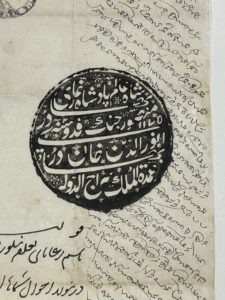
The workshop was not only informative but also a wonderful opportunity to reconnect with familiar faces from recent research visits, including Yasmin Faghihi (Cambridge University Library), Firuza Melville, with whom Theresa had previously examined manuscripts in Cambridge, and James Liu (Royal Asiatic Society). While the discussions primarily focused on inscriptions, seals, and the trajectories of manuscripts rather than decorated paper, these themes are highly relevant to our project’s wider research interests.
We would like to thank the convenors for hosting Theresa and for organising such an engaging and thought-provoking event. She looks forward to returning with her colleagues to London later this month — stay tuned for more updates!