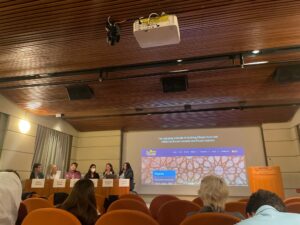
December was rich with academic events in Istanbul. On her second research week, Negar took advantage of the opportunity to attend various talks and meet scholars and researchers across disciplines. During this period, she attended one of the rare public talks by Emine Fetvacı at the ANAMED Library, which focused on an Ottoman manuscript, Kalīla wa-Dimna (کلیله و دمنه), preserved today in four museums around the world. The talk was both informative and intellectually engaging.
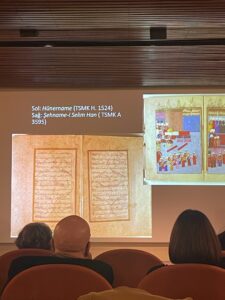
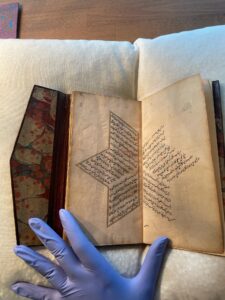
Alongside these events, Negar continued her research at the Süleymaniye Library, where she examined several decorated manuscripts. She also had the opportunity to use the small but valuable reference library within the complex, which houses Turkish printed books on art history.
The highlight of her research stay in Istanbul was her work at the Ottoman Archives, where she was able to study historical documents dating from the sixteenth century onwards. Although archival research is often associated primarily with historians, these documents also contain rich information relevant to art history, including references to artists, paper production and trade, and European merchants.
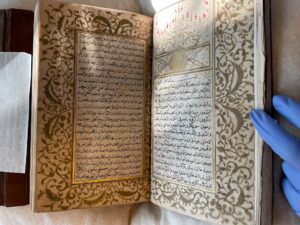
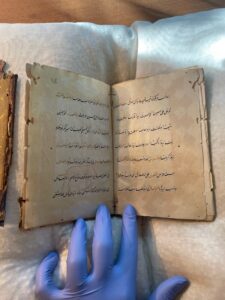
Finally, she attended a panel discussion at the ANAMED Library titled Digital Humanities and Islamic Book Arts, with contributions from Christiane Gruber, Evrim Binbaş, Aslıhan Erkmen, Ünver Rüstem, and Selin Ünlüönen. This talk mainly focused on the digitization of manuscripts and objects in libraries and museums, and its impact on art historical research. A central issue discussed was the growing tendency to examine manuscripts primarily through digital images, often without the opportunity to see and study the objects in person. The speaker addressed how this shift affects close material analysis, codicological observation, and our understanding of scale, texture, and technique. After the talk, it was a good opportunity to spend more time speaking about the relevant topic with other friends and professors.