
Putting Theory into Practice: An Internal Paper Decoration Workshop
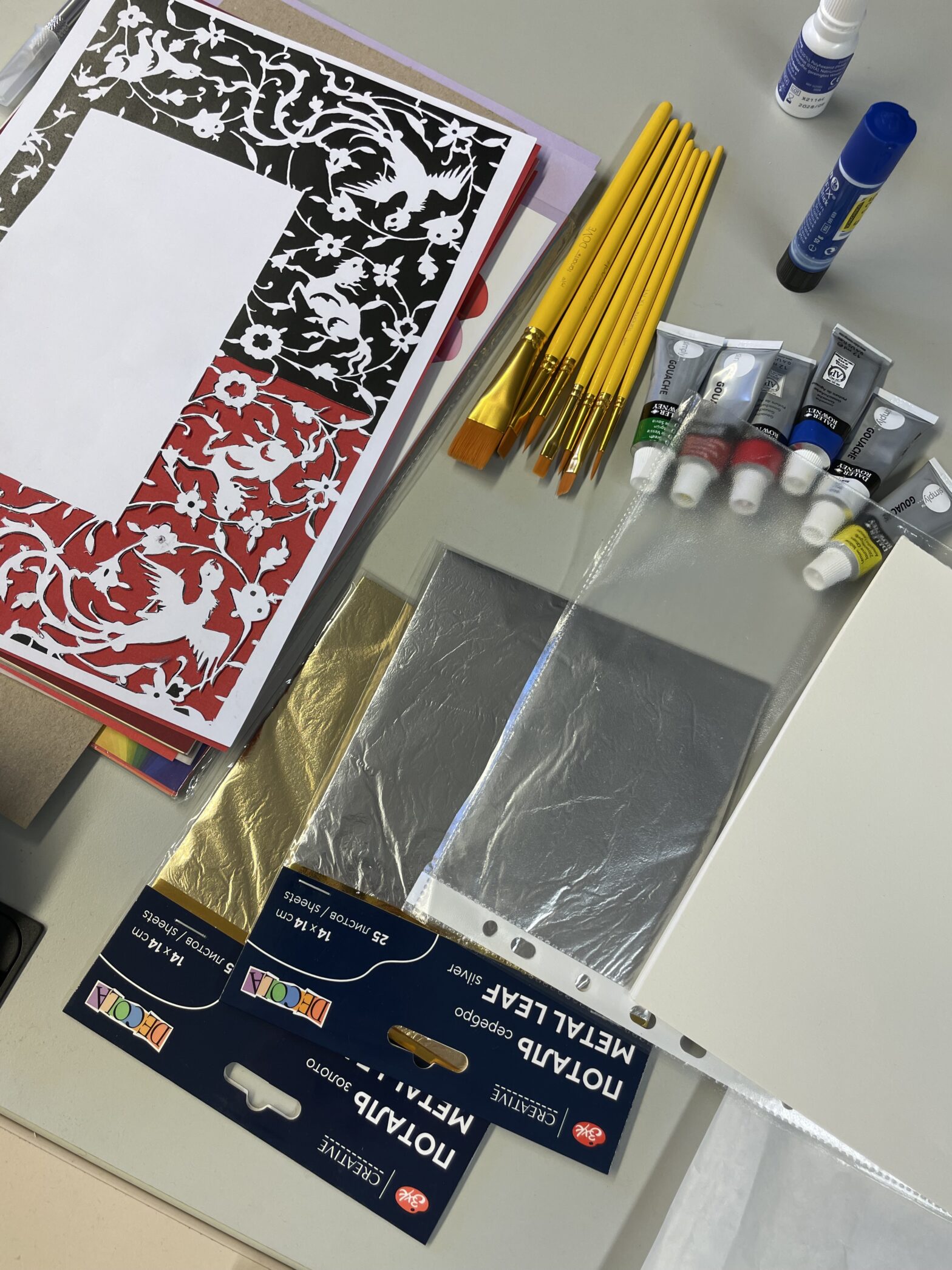
This week, the team of Global Deco Paper decided it was time to move from theory to practice and quite literally get our hands dirty. We organised an internal workshop dedicated to experimenting with historical paper decoration techniques, using a range of materials inspired by those found in the manuscripts we study.
Armed with coloured thick and thin papers, gouache paints, brushes, sponges, and even gold and silver leaf, we set out to recreate some of the effects we so often analyse in images and catalogues. Negar went a step further and prepared custom stencils, cutting them from models of Persian manuscript pages, which gave us an invaluable opportunity to work with historically grounded designs.
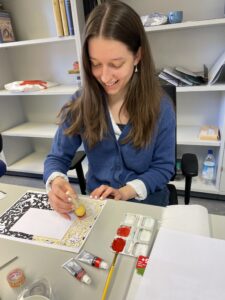
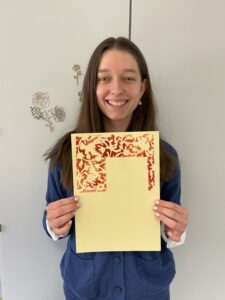
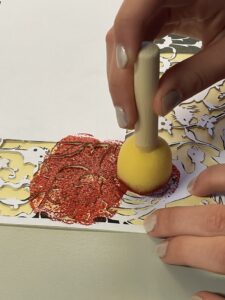
Lily, who had done much of the tracing work for the stencils, was the first to try recreating a design using a sponge. The results were immediately revealing: the final effect depended heavily on the ratio of paint to water, as well as the speed and pressure of application. Perhaps most interestingly, it became clear that layering multiple thin applications produced far more controlled and visually convincing results than attempting to achieve opacity in a single pass.
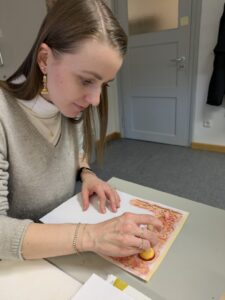
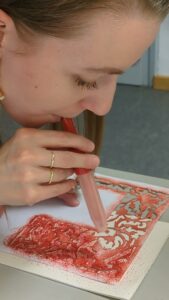
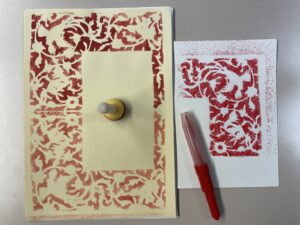
Theresa experimented with mirroring a design on the same page, carefully observing where the two patterns met and how symmetry could be maintained. She also tested a blowpen technique to apply paint, though this proved less successful for delicate and intricate designs, highlighting the limits of certain modern tools when dealing with fine historical patterns.
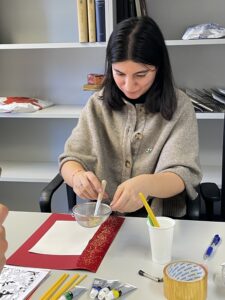
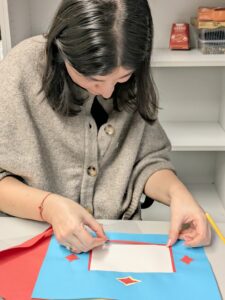
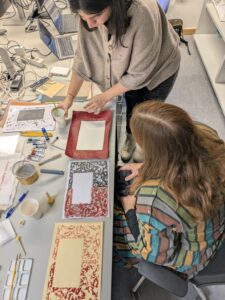
Meanwhile, Negar and Yih-chuen discussed and tested the application of glue and gold leaf through a sieve onto the margins. This technique, known from historical descriptions, requires the gold to be polished afterwards with an agate stone to achieve the desired sheen. Negar later extended her experiments by creating laminated sheets in different colours, playing with inlays and onlays, and adding internal frames or borders in contrasting tones.
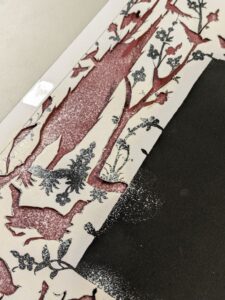
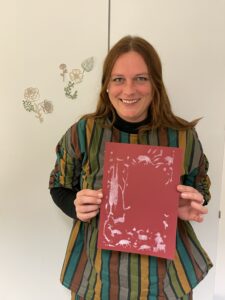
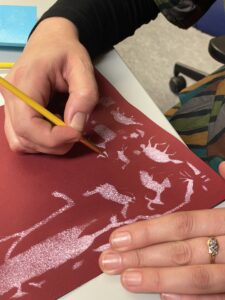
Ilse chose one of her favourite stencil motifs — a landscape with a shepherd — and rendered it in a bold, high-contrast palette: white on dark red paper. She even attempted to outline certain shapes with gold paint using a fine brush, though this quickly demonstrated another key insight of the workshop: even our “fine” modern brushes are often too coarse to replicate the extraordinary precision seen in historical manuscripts.
Overall, this short but intense practical session proved incredibly illuminating. Many techniques that seem straightforward in theory turned out to be far more complex in practice, while others yielded unexpected results. These hands-on experiments gave us a much deeper appreciation of the skill, material knowledge, and patience required of artisans in the past.
We are planning to continue this workshop at a later date, with new materials and more durable stencil sheets to push these experiments further.
Stay tuned — the theory has officially met practice, and there is much more to discover!