

CHSTM Working Group on Colour Studies: The Global Deco Paper Project Roundtable
This week, we had the pleasure of presenting our work at the CHSTM Working Group on Colour Studies, organised by Elizabeth Savage. What followed was a lively, collegial exchange with a wonderfully supportive group of peers, and we are deeply grateful for the warm reception.
A Nuanced Opening: Simon Beattie on Orange Bindings
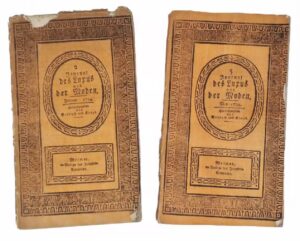
Before our panel began, antiquarian bookseller Simon Beattie offered a delightful and thought-provoking introduction on the curious prominence of orange publishers’ bindings in the eighteenth and nineteenth centuries.
He reflected on why orange – a bold, highly visible, and commercially striking colour – became so prevalent in bindings during this period. Industrial dye innovations, increased standardisation in publishers’ bindings, and the desire for immediate shelf impact in an expanding print market all may have played a role.
His remarks set the tone for the evening: colour is never merely decorative – it is technological, commercial, and cultural.
A Preliminary Survey of Fifteenth-Century Chinese Decorated Papers
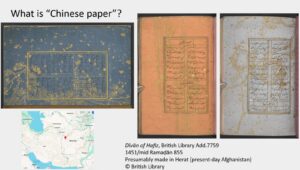
Yih-chuen Liao presented a nuanced reassessment of Ming-era decorated papers of the fifteenth century. Her preliminary survey paired material evidence with textual accounts. By doing so, she illuminated how these papers were perceived and utilised within both Chinese and Persianate contexts.
Rather than treating these papers as exotic imports, her work situates them within complex networks of exchange across land and sea routes between Ming China and the Timurid world. The result is a richer understanding of decorated paper as an active participant in cross-cultural artistic dialogue.
Introduction to Coloured Stencils
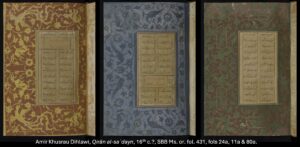
Theresa Zischkin introduced the practice of coloured stencilling in Persianate manuscripts from the fifteenth to seventeenth centuries, tracing its circulation across Greater Iran, Central Asia, and Mughal India. The presentation demonstrated how vegetal, geometric, and figural stencil motifs animated manuscript margins with vivid chromatic interplay.
Far from being a marginal craft, coloured stencilling emerges as a modular and highly adaptable system. Its repeatability and experimentation in colour combinations emphasise how stencils shaped visual rhythm and aesthetic coherence while also participating in broader material and technical exchanges.
Coloured Papers in the Dîvân-i Muḥibbî
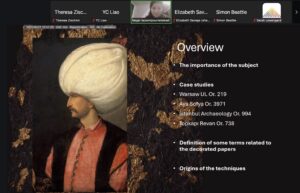
Negar Kazemipourleilabadi turned our attention to four sumptuous manuscripts of the Dîvân-i Muḥibbî by Suleiman the Magnificent. These manuscripts – now in Warsaw and Istanbul – feature elaborately coloured and gold-flecked papers, alongside distinctive silhouetted designs.
Her analysis explored both the political and artistic motivations behind their production during the Sultan’s lifetime. Particularly fascinating was the discussion of Ottoman impressed “silhouette” techniques: rather than stencilling pigment onto the surface, artisans pressed designs between sheets, creating repeated impressions from matrices. It proved to be a fascinating case study of technical innovation situated within imperial cultural ambition.
Primary Textual Sources on Paper Marbling
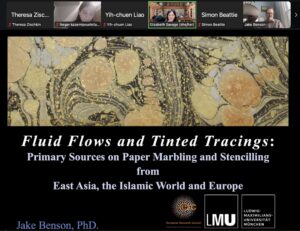
The roundtable concluded with Jake Benson’s compelling presentation on surviving textual sources for paper marbling techniques. Drawing on thirty written sources in twelve languages, Jake challenged long-standing narratives that position marbling as originating in East Asia and then transferring westward in a linear fashion. Instead, these sources reveal a more dynamic scenario: incomplete knowledge circulated, prompting independent experimentation and innovation across regions.
His forthcoming publication promises to reshape how we think about technological transmission: not as simple diffusion, but as iterative reinvention.
Decorated Papers as Transformative Technologies
The Global Deco Paper Project investigates different decorated papers across East Asia, the Islamic world, and Europe. What unites these diverse materials is their technological impact. They were not simply beautiful surfaces. They transformed manuscript and book production in the early modern period, reshaping aesthetics, trade networks, workshop practices, and even the economics of bookmaking.
Beyond the scholarship, what made the evening truly special was the atmosphere: engaged discussion, interesting questions, and genuine collegiality. It was a joy to share our work within such a thoughtful and supportive community. Thank you to the CHSTM Working Group on Colour Studies – and especially to Elizabeth Savage – for hosting us. We had tremendous fun and look forward to continuing these conversations across borders and pages!