
New Perspectives on Knowledge and Making: Reflections from the 38th German Congress of Art History in Munich
Attending the 38th German Congress of Art History in Munich was an inspiring and intellectually energising experience for our team. As researchers working on decorated paper, we were particularly interested in how this year’s central theme Knowledge would resonate with our own questions about materials, techniques, and cultural exchange. The congress not only met our expectations but broadened them significantly, offering new methodological perspectives and conceptual frameworks for approaching decorated paper as a medium of knowledge production.
The congress was opened by Ulrich Pfisterer, who set the tone with a compelling reflection on the agency and impact of images as well as the global networks created through visual media. He emphasised the importance of collective visual knowledge for the discipline of art history and addressed images as seemingly universal media of communication and knowledge. Particularly stimulating was his call for a transdisciplinary history of knowledge, encouraging art historians to consider how images operate across cultural, material, and epistemic contexts. For scholars of decorated paper, this perspective reinforces the idea that the decorative surfaces on paper – marbled, sprinkled, or stencilled – participate in visual knowledge systems that transcend geographic boundaries.
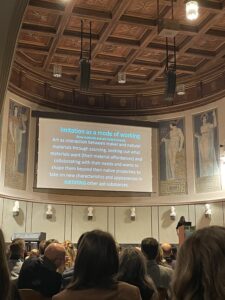
The keynote lecture further expanded these ideas by exploring human–material interactions through the lenses of sourcing, making, and knowing. A key argument was that making itself catalyses partnerships between humans and materials, suggesting that knowledge is not merely transmitted but generated through physical engagement with matter. This approach resonates strongly with decorated paper research, where processes such as marbling or gold sprinkling involve embodied knowledge that cannot be fully captured in written sources alone.
Throughout the congress, numerous panels showcased fascinating international research. One presentation examined how technical knowledge circulated among sixteenth-century German tailors’ workshops. The speaker demonstrated how information was selectively shared and withheld, travelling through books and people yet simultaneously protected by guild structures. Similarities in patterns across towns revealed networks of exchange, while local adaptations testified to creativity rather than simple copying. This dynamic parallels decorated paper production, where recurring motifs across regions suggest transmission of techniques, yet local variations in colour, pattern density, or execution reveal individual workshop identities.
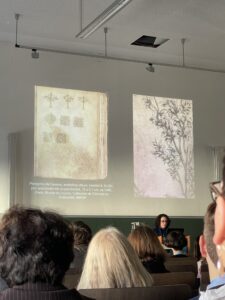
Another particularly intriguing talk addressed metalwork as a paper medium, analysing the evolving relationship between metal substrates, niello techniques, and ornamental design. The discussion highlighted how materials traditionally considered separate could intersect conceptually and technically. Such cross-material thinking invites comparisons with decorated paper, where metallic effects – such as gold-sprinkled surfaces – simulate precious materials or stencilled designs could be used across media.
A project presentation on the famous “Schwarzen Mander” sculptures in Innsbruck offered insight into the complexities of restoration and conservation practices, demonstrating how the present appearance of an artwork is often the result of multiple historical interventions rather than an original state. For decorated paper, this raises similar questions, since colours, surface treatments, and coatings may have altered over time, complicating attempts to reconstruct original techniques or workshop practices.
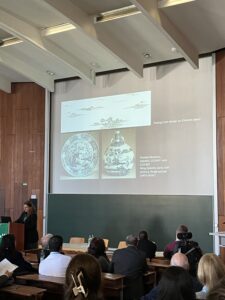
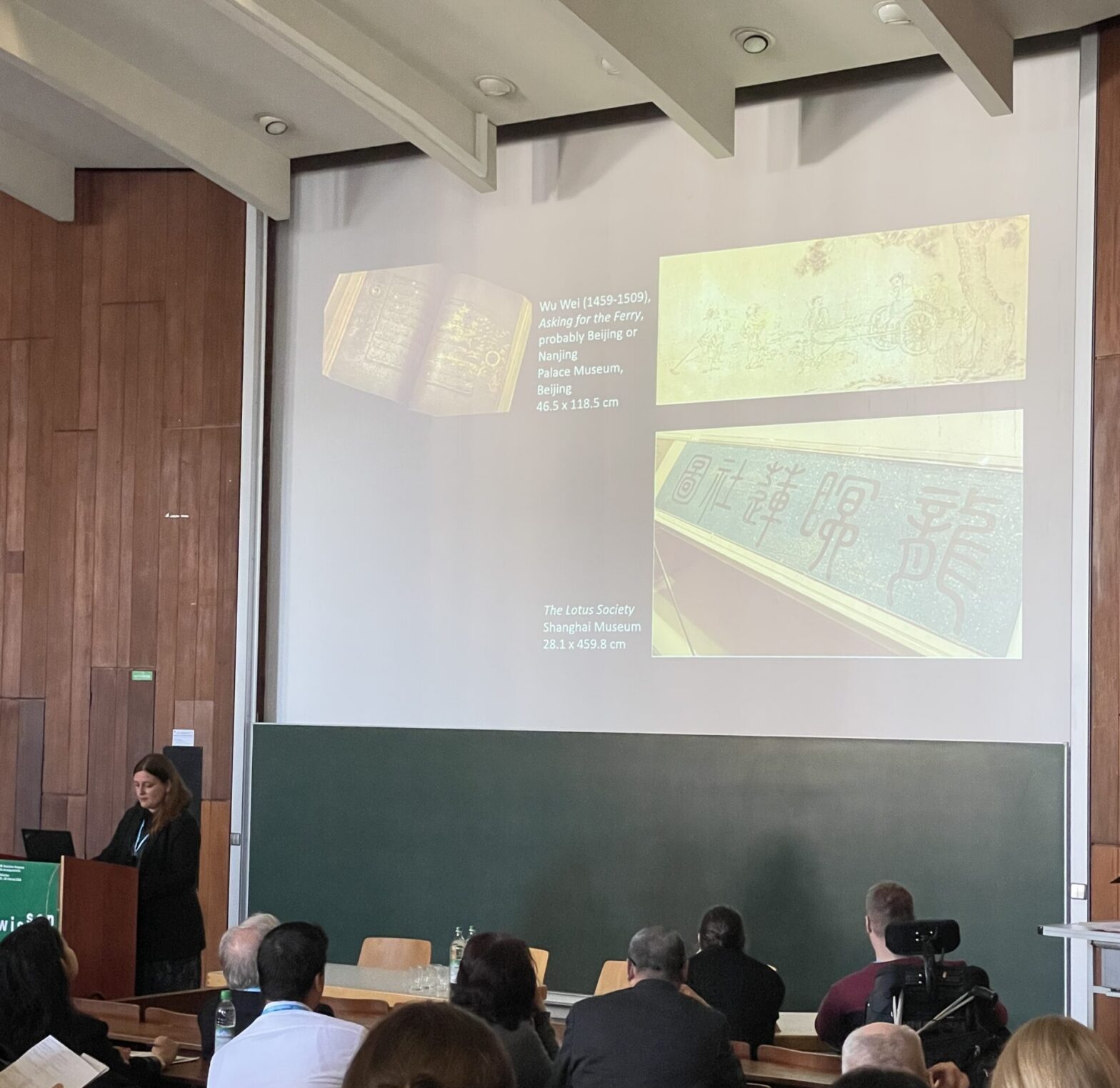
A highlight was the panel curated by PI Ilse Sturkenboom: “Image Studies Made Effortless”: ‘Glocal’ Non-Knowledge in the Visual Arts. In her introduction, she presented examples of decorated paper to demonstrate artistic transfers between China and the Persianate world, effectively situating our research within broader debates on global and local knowledge.
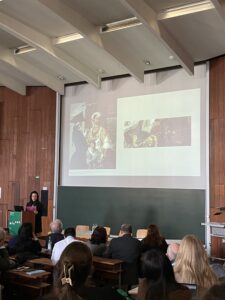
One paper explored the pineapple as a decorative spectacle in early modern knowledge cultures, emphasising its multiple symbolic and political meanings. This topic connects to decorated paper insofar as stylised botanical forms often circulated across media, including stencilled or silhouetted papers that transformed objects into repeatable ornamental patterns.
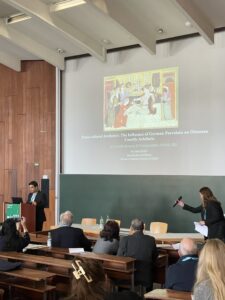
Another engaging paper examined the influence of German Meissen porcelain on Ottoman courtly artefacts in the eighteenth century, showing how imported coffee cups functioned as luxury goods, symbols of prestige, and carriers of transcultural knowledge within elite social rituals. By highlighting processes of selective adaptation and aesthetic reinterpretation, the talk demonstrated how small objects could mediate complex cultural exchanges between Europe and the Ottoman world. This approach is highly relevant to decorated paper, as marbled, coloured, or gold-sprinkled papers similarly circulated across regions, transmitting visual ideas and techniques while being locally transformed to fit new cultural contexts.
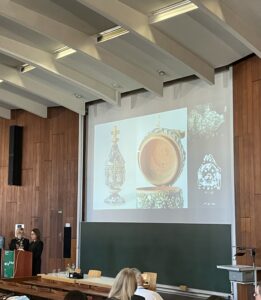
In another panel on the materiality and epistemic potential of containers of knowledge, equally compelling parallels emerged. Decorated paper can be understood as a “container of knowledge” in an open sense, in which sensory perception, materiality, and cultural attributions interact. Much like historical artworks whose supposed knowledge later proves mistaken, attributions concerning the technique, origin, or function of decorated papers are often the result of inherited assumptions that can only be reassessed through new material and technical analyses. Their surfaces – whether sprinkled, marbled, or stencilled – create deliberate dynamics of opacity and transparency: they reveal artisanal skill while simultaneously obscuring processes of production. Within collections, exhibitions, and research contexts, decorated paper thus becomes an active site of knowledge production, where materially embedded practical knowledge, historical interpretations, and the perspectives of contemporary scholars intersect.
For our project, this environment was immensely productive: it encouraged us to think of decorated paper not merely as a supporting material for manuscripts but as an active participant in global knowledge systems – one that embodies technical expertise, aesthetic values, and cultural encounters. We left with new questions, fresh perspectives, and a renewed sense of how our research fits into larger conversations within art history. The congress demonstrated that studying materials such as decorated paper can contribute meaningfully to debates about knowledge, making, and the movement of ideas across cultures – precisely the kind of interdisciplinary dialogue that the field increasingly seeks to foster.