

GLOBAL DECO PAPER at the Fourth German South Asia Day in Erfurt
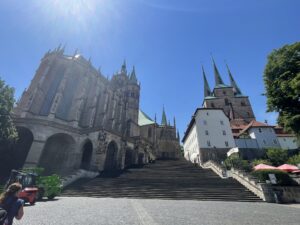
Project PI Ilse Sturkenboom and Theresa Zischkin participated in the Fourth German South Asia Day, held this year at the University of Erfurt. After arriving around noon, they began the day with lunch and a short walk through Erfurt’s old town, including a visit to its art-historically fascinating cathedral. They then continued to the university, where the conference programme opened with a panel on literature and object cultures.
Ilse and Theresa were the second speakers in this first panel. Their presentation focused on stencilled paper between Central Asia and Mughal India, exploring questions of exchange, mobility, and appreciation in the early modern period. The talk introduced a group of decorated papers used as manuscript frames, onto which contrasting patterns were applied with the help of stencils. These papers display recurring floral, geometric, zoomorphic, and figural motifs in both positive and negative designs, as well as in horizontal and vertical formats. The repeated appearance of identical patterns in different manuscripts suggests that such papers may have been produced in one or more specialised workshops. The talk also addressed the methodological difficulties of dating and locating these decorated frames, since they were not always produced at the same time as the copied text. Codicological evidence, ownership notes, seals, and bindings can therefore provide important terminus ante quem evidence. The material points especially to two major cultural spheres in which these papers circulated: Transoxania and the Mughal Empire. Based on these observations, the presentation proposed hypotheses about artistic exchange, material mobility, and mutual appreciation between these regions. The paper received valuable feedback, particularly on questions of materiality, possible feedback loops created by the commercial manuscript market, and quantitative approaches to the corpus. These comments will be very helpful for further developing the project’s research questions.

The conference programme brought together a wide range of stimulating papers. Among them was a presentation on the transmedial use of textual fragments in the Islamic architecture of colonial Malabar, which examined how texts from portable media such as books were transferred onto the walls of mosques. Another talk explored the Gangavatarana, the descent of the Ganga, and its retellings in French travel literature of the twentieth and twenty-first centuries. Other contributions addressed difficult but important histories, including German-Iranian connections in Berlin between 1933 and 1945 and the use of research and scholarship to support ideological agendas. Further papers discussed Annemarie Schimmel, her writings on the history of religions, and her impact on scholarship and translation in different intellectual contexts.
The breaks offered many opportunities for lively discussion, exchange, and networking with other participants. The keynote lecture titled “Time as Infrastructure,” reflected on service culture in digital India and provided a thought-provoking addition to the preceding academic programme.
The evening ended with a concert, “Echoes of Ancient Strings,” which offered a contemporary interpretation of traditional Raga music with sitar and tabla. After a full day of diverse research topics and complex discussions, the meditative music provided a calm and soothing close to the event.
Despite the heatwave and delays in the German train system, Ilse and Theresa greatly enjoyed the exchange in Erfurt. They would like to warmly thank the organisers Isabella Schwaderer, Sara Keller, Carmen Brandt, Johanna Buß, and Ira Sarma for putting together such a rich and engaging programme.