
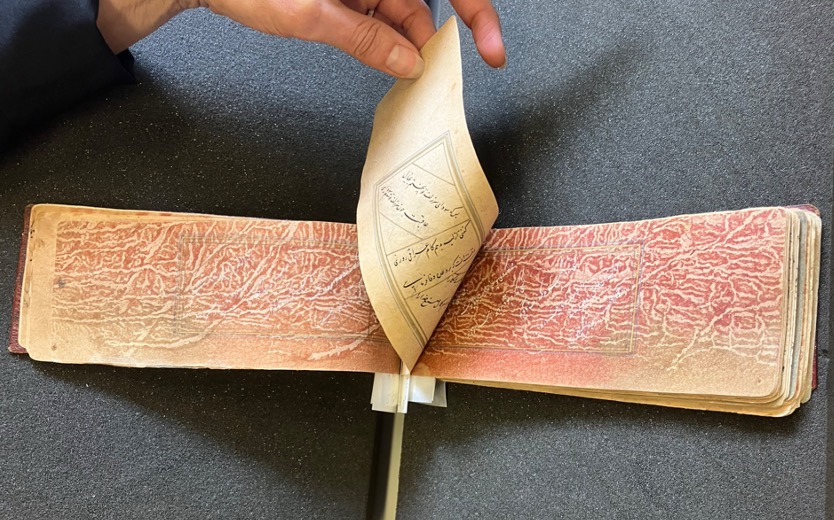
New York City, April 2026 Part II: A late 15th-century Timurid-era safina manuscript.
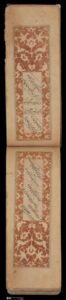
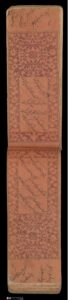
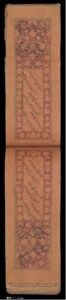
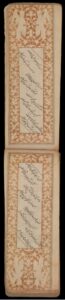
Conjugate central bifolia of reflecting, intricate sprayed stenciled designs in Metropolitan Museum of Art, 19971.91 (l–r), folios 16v=17r, 70v=71r, 73v=74r, and 77v=78r. Images courtesy of the Metropolitan Museum of Art.
In this second instalment, Dr. Jake Benson examined a damaged and incomplete, but nevertheless highly significant safina, an Arabic-derived term for ‘boat’ but here referring to an oblong book bound on the short end held in the Metropolitan Museum of Art (1997.71.). Probably completed in Herat, located in what is now Afghanistan during the twilight of the Timurid dynasty (1370–1507), the manuscript contains selections of ghazal (lyric) poems, many excerpted, from well-known poets such as Amīr Khusrau (1253–1325), Ḥāfiẓ (ca. 1325–1390), Kamāl Khujandī (ca. 1320–1401), ‘Ārifī Haravī (ca. 1390–1449), and Jāmī (1414–1492). Notably, the volume also features several poems by Timurid prince Ẓahīr al-Dīn Muḥammad Bābur (b. 1426, r. Mughal Emperor 1526–1530), who ultimately defeated the Lodi Sultanate of Delhi and established the Mughal dynasty (1526–1857) in India.
Calligrapher Sulṭān Muḥammad Nūr (fl. ca. 1472–1536), whose signs his full name as ‘Sulṭān Muḥammad bin Nūrallāh’ on the final folio 86v this manuscript, carefully copied the text in black, white, and gold inks. A highly admired scribe, he trained under nastalīq script master Sulṭān ‘Alī Mashhadī (d.1520) in the royal library of penultimate Timurid ruler Sulṭān Ḥusain Baiqarā (b. 1438, r. 1469–1506) in the then capital city of Herat. He signed one entry dated 905 AH (1499–1500 CE), ironically shortly before Bābur launched a famously failed siege of Samarkand the following year. Hence, this manuscript offers readers a glimpse into Timurid literary culture during its final moments, shortly before it fell to invading Uzbek forces.
Together with paper conservator Yana van Dyke, Jake examined various forms of richly coloured tinting and decoration applied to different folios in contrasting colours. Several central bifolia feature delicately sprayed, mirrored filigree paper-cut stencils, with birds, animals, and angels, including several executed on tinted backgrounds. Other richly hued, erratic ‘trickled’ designs bear distinct rivulets. Critically, after the artists prepared, cut down, folded, and assembled the decorated papers into folios to be sewn, they preserved two folios cut from the edge of one of these trickled paper designs, careful study of which sheds further light on the exact procedures the artists employed to form them.
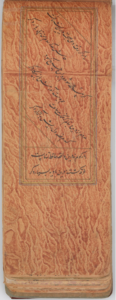
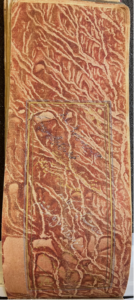
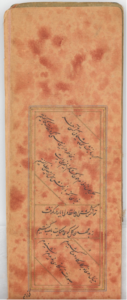
‘Proto-marbled’ ‘trickled’ designs with an impression left by the clothesline on which the artist hung it up to dry on folio 52r (left) irregular, large voids formed by dispersants and surface tension on folio 56v (middle) and diffuse ‘wet-in-wet’ spattering on 62v (right). Images courtesy of the Metropolitan Museum of Art.
Regrettably omitted in surviving sources on Turco-Persian paper decoration, the design appears predominantly composed of a warm, somewhat transparent reddish brown colour, which leaves the papers flexible. Hence the ‘trickled’ papers in this volume may be made from seed or button lac saponified with borax to render it miscible in water. It appears the artists first tinted the sheets, in this case, in a pale violet tone. Afterwards, they applied the reddish brown colourant, followed by a clear liquid dispersant which caused the colour film to crack and curdle. Afterwards the artists apparently then lifted the papers up and allowed the colour and dispersant to dribble off, resulting in long, distinctive streaked rivulets. Adding a second application of dispersant perpendicular to the first then lifting it up again formed ‘criss-crossed’ rivulets. One of the folios retains the impression of a clothesline where it was hung to dry. In 1997, Francis Richard first proposed that these papers may have inspired paper marbling technology, on which basis, Sheila Blair referred to them as ‘proto-marbled’ papers.
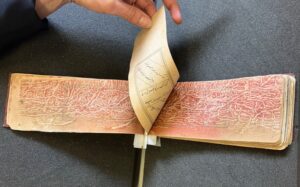
These ‘trickled paper’ designs on conjugate bifolium 6v=9r, feature erratic, criss-crossed rivulets except at the bottom, which appears to be the outer edge of the full sheet. Image by Jake Benson, courtesy of the Metropolitan Museum of Art.
However, the manuscript is also significantly damaged in several areas, and regrettably incomplete. Close scrutiny of the gutter margins reveals thirty-one instances of erased, altered, or mismatched catchwords. Another folio, now 57v bears the signature of calligrapher Sulṭān Muḥammad Nūr dated 905 AH (1499–1500 CE), appears displaced, since the catchword on the prior page matches the folio following. In her description of the manuscript, Denise-Marie Teece notes a strikingly similar folio mounted as an album folio, sold at auction. Since the tone of the tinted paper, hand, layout, number of lines, and even the gold and white inks all match folios in the Metropolitan manuscript, it must be detached from it. Therefore, by identifying poems where losses occur may potentially reveal further detached and dispersed folios now located elsewhere.
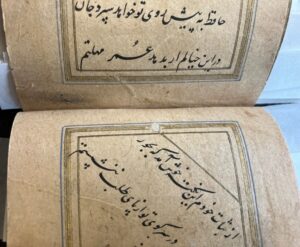
An obliterated catchword in the gutter margin on folio 58v. Image by Jake Benson, courtesy of the Metropolitan Museum of Art.
Ironically, the ‘trickled’ designs in this manuscript closely resemble a cut paper flower found at Dunhuang dated 500 years earlier. However, this sole, isolated surviving example of this paper, while strikingly similar, cannot sufficiently prove that this ‘trickled’ paper method ‘originated’ in China and ‘transferred’ to the Islamic world. Furthermore, the Montgolfier Mill in Annonay, France famously manufactured what they called papiers coulé (smeared papers) and papiers croisé (crossed papers), which ironically resemble the designs in the manuscript, but no evidence survives to suggest that those French manufacturers ‘learned’ the technique from Turco-Persian artists. Together, they constitute three isolated periods of production of ironically similar designs undoubtedly produced by comparable techniques, independently achieved through experimentation.
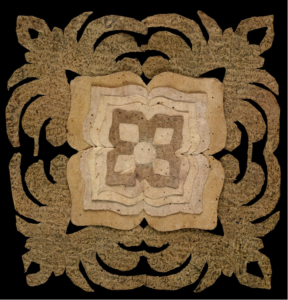
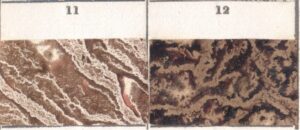
Top: papercut flower bearing ‘trickled’ designs from Mogao Cave 17, Dunhuang, early 10th century. London British Library Or.8210/S.11633A. Image courtesy of the British Library Dunhuang Project).Bottom: samples of papier coulé and croisé manufactured by the Montgolfier firm, Annonay, published by M. Fichtenberg in 1852.
This point proves particularly salient when discussing paper marbling history, as prior scholars often alleged that it also ‘came from China’ and ‘travelled the Silk Road’ analogous to the history of paper itself. However, that specious supposition overlooks how famous kinds of paper made in China, such as ‘Golden-nut Mountain Sutra Paper’ flourished during the medieval period, then declined and died out, only to be later ‘revived’ using entirely different methods during the reign of the Qianlong Emperor (b. 1711, r. 1735–1799). In contrast, emerging physical evidence increasingly intimates a far more complex scenario of isolated, independent inventions of ironically similar methods, including these ‘proto-marbled’ or ‘trickled’ designs. Technical analysis may reveal whether preparations for these Turco-Persian ‘trickled’ papers might derive from lac saponified with borax, possibly additional surfactant saponins derived from plants like soapberry (Sapindus mukurossi). If so, that same formula, which appears in surviving technical accounts for paper marbling, would prove that art directly emerged from indigenously produced, Turco-Persian proto-marbled ‘trickled’ designs as first proposed by Richard.
With special thanks to Yana van Dyke and the Metropolitan Museum of Art Paper Conservation Department.
Sources:
Sheila Blair, ‘Gold and Color: The Decorated Papers Used in Manuscripts in Later Islamic Times’ Muqarnas Vol. 17 (2000), p. 31.
Idem, Islamic Calligraphy (Edinburgh: University of Edinburgh Press, 1997), pp. 54–55.
Stefano Carboni, Daniel Walker, and J. Kenneth Moore, ‘Recent Acquisitions: A Selection, 1997 – 1998: Islam’ in The Metropolitan Museum of Art Bulletin, n.s., Vol. 56, Nº 2 (Fall 1998), p. 11.
Yana van Dyke, ‘Casting Light on the Surface, Scientific Exactitude Meets Poetic Inspiration: A Close Look at Six Objects from the Islamic Collection of The Metropolitan Museum of Art’ Hand Papermaking Vol 27 Nº 2 (Winter 2012), p. 20, fig. 5.
M. Fichtenberg, Nouveau manuel complet du fabricant de papiers de fantaisie : papiers marbrés, unis, piqués, jaspés, bois, granits, satinés, maroquinés, gaufrés, moirés, dorés, argentés, de la peau d’ane factice, papiers métalliques, impression à la congrève, de la fabrication de la cire à cacheter, crayons de mine de plomb, des plumes à écrire, des pastels, etc.: ouvrage orné de modèles de papiers (Paris: Roret, 1852), pp. 71–76, and ‘carte d’échantillons’ Nº 11 and 12.
idem, New and Complete Manual on the Making of Fancy Papers, trans. Richard J. Wolfe (Wilmington, DE: Oak Knoll, 2010), pp. 72–77, pl. 2, Nº 11 and 12.
Francis Richard, Les Splendeurs Persane: Manuscrits du XIIe au XVIIe siècle (Paris: Bibliothéque Nationale de France, 1997), pp. 64, 83, 99–100, Nº 49, 54, and 55.
Denise-Marie Teece, ‘Anthology of Persian Poetry in Oblong Format (Safina)’ in Masterpieces from the Department of Islamic Art in The Metropolitan Museum of Art, ed. Sheila Canby et al (New York: Metropolitan Museum of Art, 2017), pp. 187–188, Nº 126.
Richard Wolfe, Marbled Paper: Its History, Techniques, and Patterns: with Special Reference to the Relationship of Marbling to Bookbinding in Europe and the Western World (Philadelphia, University of Pennsylvania Press, 1990), pp. 114–115, pl. XX, Nº 8–9 and XXI, Nº 1–3.