
Putting Theory into Practice II: Testing Methods for Creating Silhouetted Paper
For our second practical workshop, the GLOBAL DECO PAPER team turned to the question of silhouetted paper: How might these delicate impressions have been created, and which materials, tools, and paper supports produce the most convincing results?
We began the afternoon by looking at a range of papers that could be used for our experiments. These included ordinary printing paper, thin Japanese paper, thicker craft paper, and handmade linen-pulp paper that Theresa had produced during her paper-making workshop in Paris. The different papers varied considerably in thickness, texture, absorbency, and surface structure, all of which proved highly relevant for the outcome of the tests.
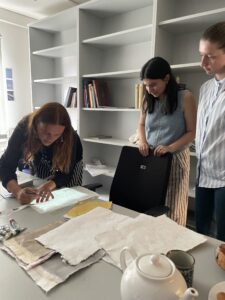
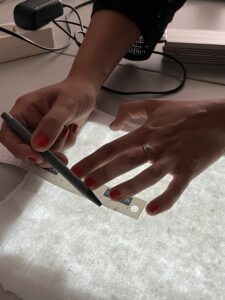
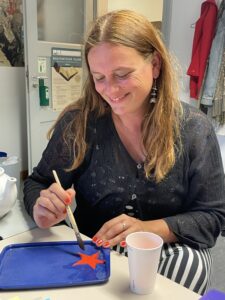
The next question concerned the colouring materials. We decided to work with gouache paints in different colours, as well as a dye made by cooking loose tea leaves. Negar had already prepared a felt sheet with a full-sheet negative cut, with small plant shapes cut out of the felt. Since this felt had already been used the week before and had dried afterwards, it had become relatively firm and stiff. In contrast, we also worked with a second, softer and more malleable felt sheet, from which we cut star and rhomboid shapes. For these experiments, we used both the positive cut-outs and the remaining negative-cut sheet.
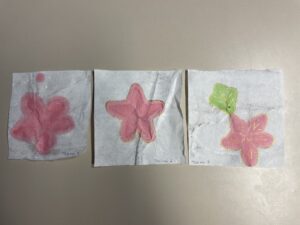
Several test runs were carried out on the different paper types. The best results were achieved with the handmade linen-pulp paper. One important observation was that the felt should not be soaked too heavily. When too much colourant was present, the pigment bled significantly into the paper. Like with historical silhouetted paper, the colour also migrated from the A side to the B side. When an almost dry and stiffer felt was used, however, it left a more textured imprint without migrating through the sheet. This result was almost reminiscent of stencilling, with the motif appearing as a more “speckled” surface impression.
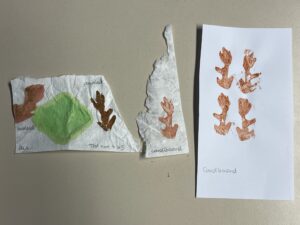
We also tested cardboard instead of felt. Unlike the felt, the cardboard did not absorb the paint in the same way. As a result, the colour did not migrate to the other side of the paper. The surface texture of the imprint appeared veiny, and the colour tended to pool around the edges of the shape. This produced a very different visual effect and made clear how strongly the material of the tool influences the final appearance.
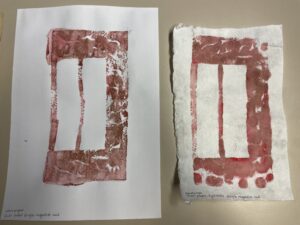
The full-sheet negative-cut felt was then tested in different ways. At first, when we pressed the felt tool between two sheets of ordinary printing paper, the result showed considerable bleeding. With a thicker paper, the outcome improved, and the outlines became more visible. Once again, the handmade linen paper produced especially promising results. Since the felt was dry in some areas, the colour did not migrate evenly to the other side, which created a more varied and nuanced impression.
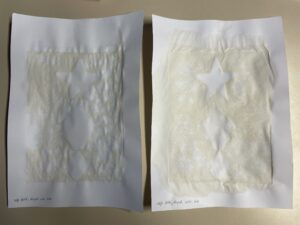
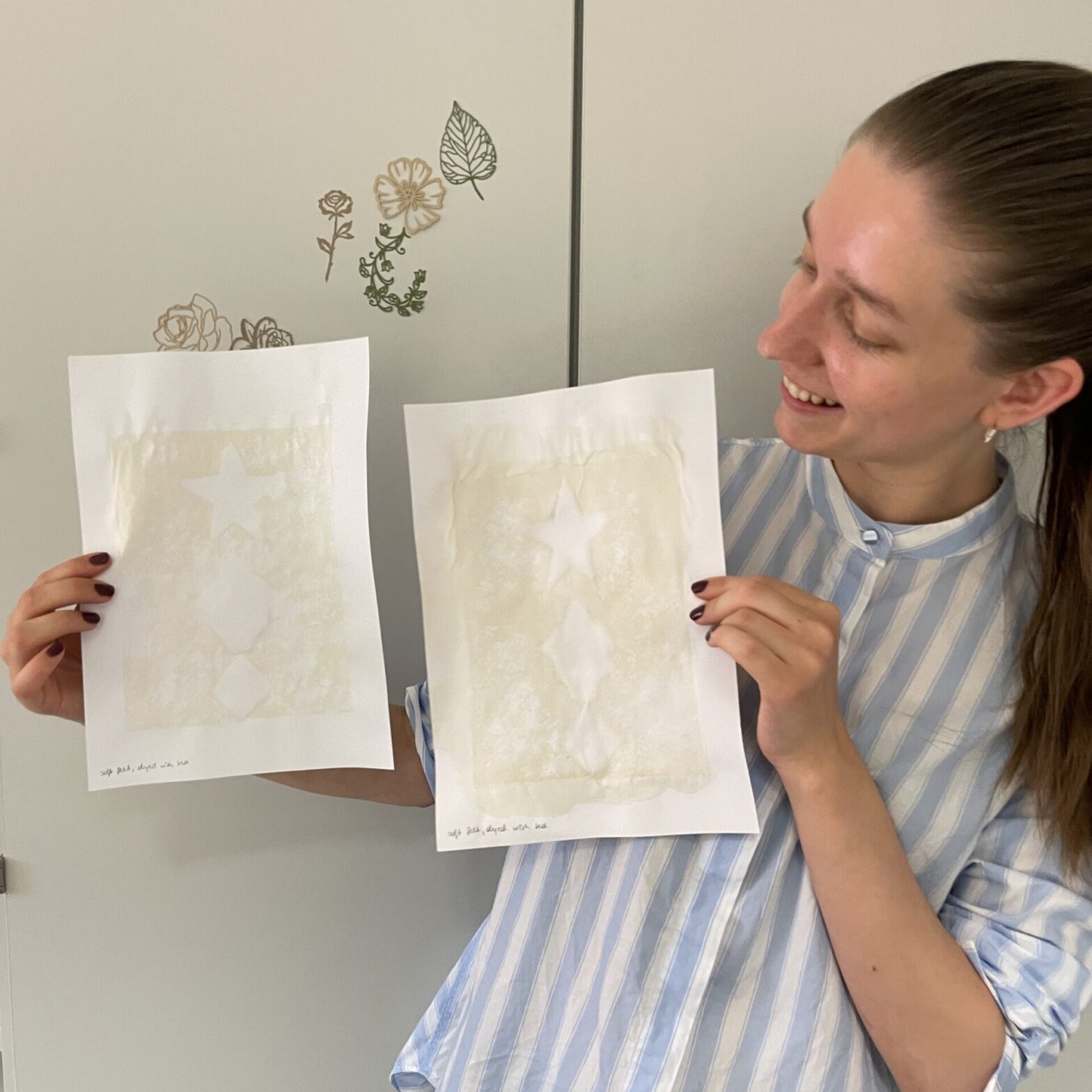
We also repeated the experiment with the soft felt sheet, which we dyed with black tea. Since the tea had only been left to sit for about one hour rather than overnight, the impression remained relatively faint. On printing paper, however, the tea did pass through to the other side, and the imprint was quite strong. Visually, this result came closer to the soft, pastel-like colouring often associated with silhouetted paper.
As part of the workshop, we also measured the thickness of the different papers. The Japanese paper, at only 0.09 mm, did not work well for this technique: it appeared too thin, and the colour bled too much. Theresa’s handmade linen paper measured between 0.17 and 0.24 mm and had visible laid lines, with 20 lines measuring 5.2 cm. This paper proved much more suitable and gave some of the most convincing results of the afternoon.
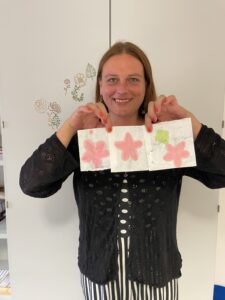
The workshop showed that silhouetting is considerably more complex than expected. Many factors contribute to a successful result: the choice of paper, the possible preparation of the paper through sizing, the type and concentration of the dye or pigment, and the texture, stiffness, and absorbency of the felt tool. The experiments also showed that very small changes in moisture, pressure, and material can produce very different visual effects.
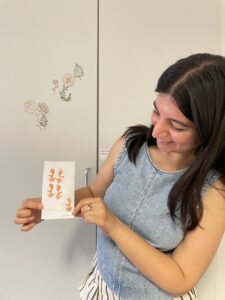
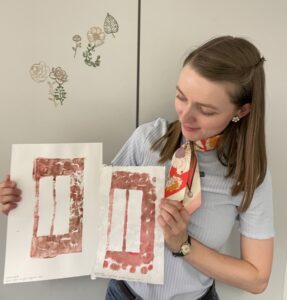
While we did not arrive at one definitive method, the afternoon offered many valuable insights and opened up new questions for future experiments. The team will continue testing further combinations of paper, colourants, and tools in order to better understand how silhouetted paper may have been produced historically.
All in all, it was a productive and enjoyable afternoon of hypothesising, experimenting, and observing – and, of course, sharing delicious cakes afterwards.