
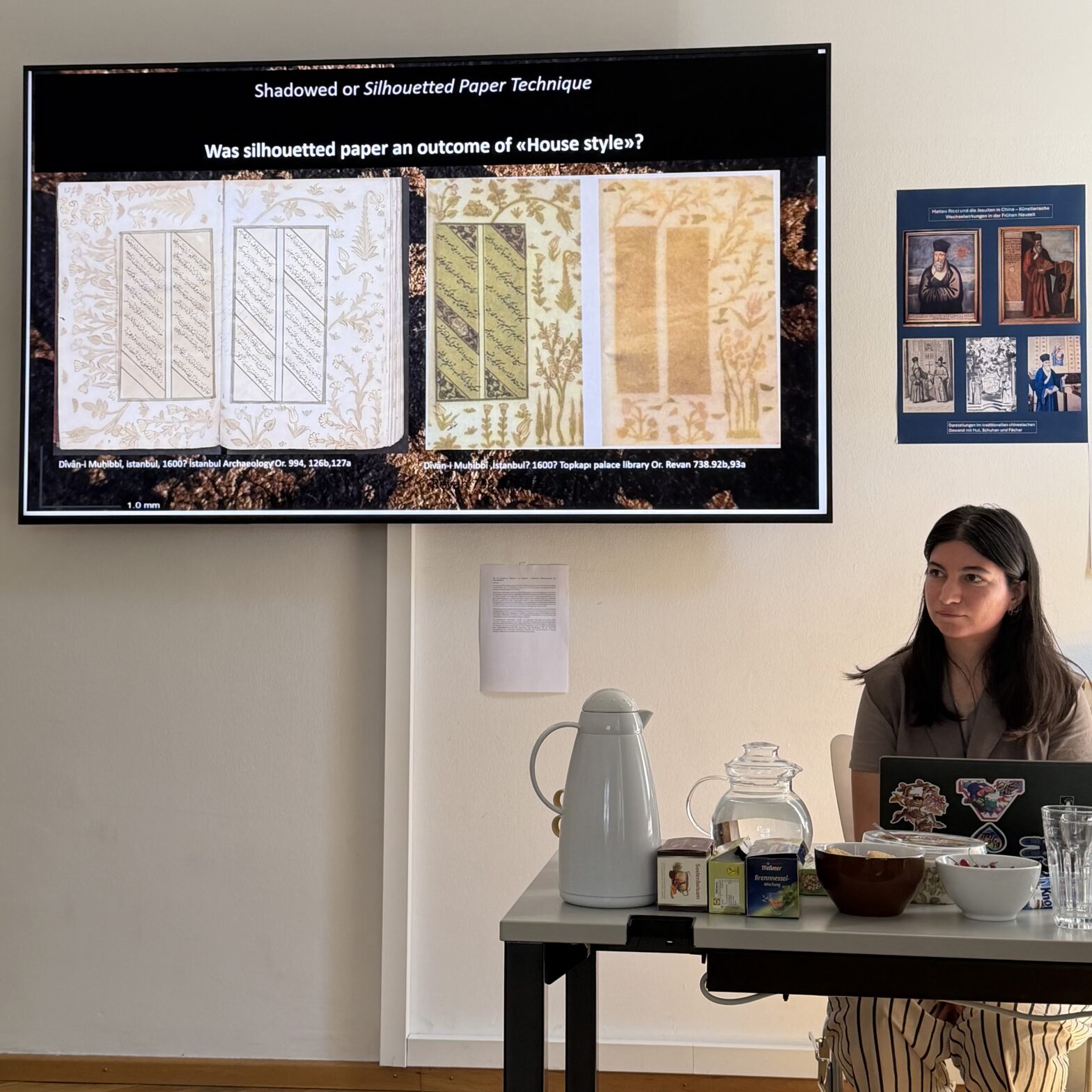
New Research and Shared Perspectives: PhD Colloquium
This week, a two-day colloquium brought together the doctoral researchers supervised by our Principal Investigator, Prof. Dr. Ilse Sturkenboom. More than ten participants presented the latest developments in their dissertation projects, making the event a valuable opportunity to discuss work in progress, exchange ideas, and receive feedback from colleagues. Several members of the GLOBAL DECO PAPER team were among the presenters.
Negar offered new insights into the Ottoman context of Sultan Süleyman’s Dīwān-i Muḥibbī manuscripts. Her contribution focused particularly on the silhouetted and otherwise decorated papers found in these volumes, which will form an important part of her doctoral research. By examining the relationship between paper decoration, manuscript production, and the courtly context of the Dīwāns, she opened up new perspectives on these richly conceived objects.
Hanieh discussed the potential of artificial intelligence for image curation and the study of stencilled paper. Drawing on her expertise in information technology, she explored how artificial intelligence might assist in identifying, organising, and comparing large numbers of visual examples. As she now turns more fully towards stencilling in her research, these methods may offer promising new ways of recognising recurring designs and tracing relationships between manuscripts.
Lily, who is at the beginning of her doctoral project, presented her research topic to the group for the first time. She plans to investigate painted frontispieces in fifteenth- and sixteenth-century Persian manuscripts. Building on the statistical codicological approach developed in her award-winning MA thesis, she will examine the front matter of manuscripts and consider how frontispieces relate to the structure, decoration, and conception of the book as a whole.
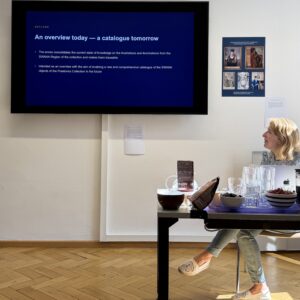
At a very different stage of the doctoral process, Mandana presented the appendix to her dissertation, which is now approaching completion. Her contribution introduced objects from the Preetorius collection, including examples featuring decorated paper, and demonstrated the importance of detailed documentation and cataloguing for the study of historical collections.
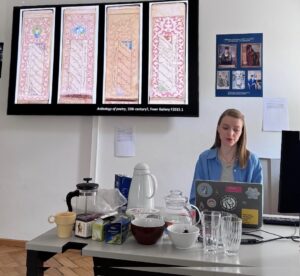
Theresa presented a theoretical model that she is considering for her dissertation on stencilled paper. She also provided an overview of early case studies of stencilling and proposed a classification of stencil designs. The discussion addressed how such a model might account for the adaptation of stencilling across different regions and periods without assuming a linear development.
Alongside the presentations, individual meetings with Ilse offered participants the opportunity to discuss their projects in greater depth. The colloquium concluded with a barbecue, providing a relaxed setting in which conversations could continue beyond the formal sessions.
The two days were filled with stimulating discussions, constructive feedback, and a fruitful exchange of ideas between researchers working on different aspects of Islamic art and manuscript culture. We are already looking forward to the next PhD colloquium in February.