
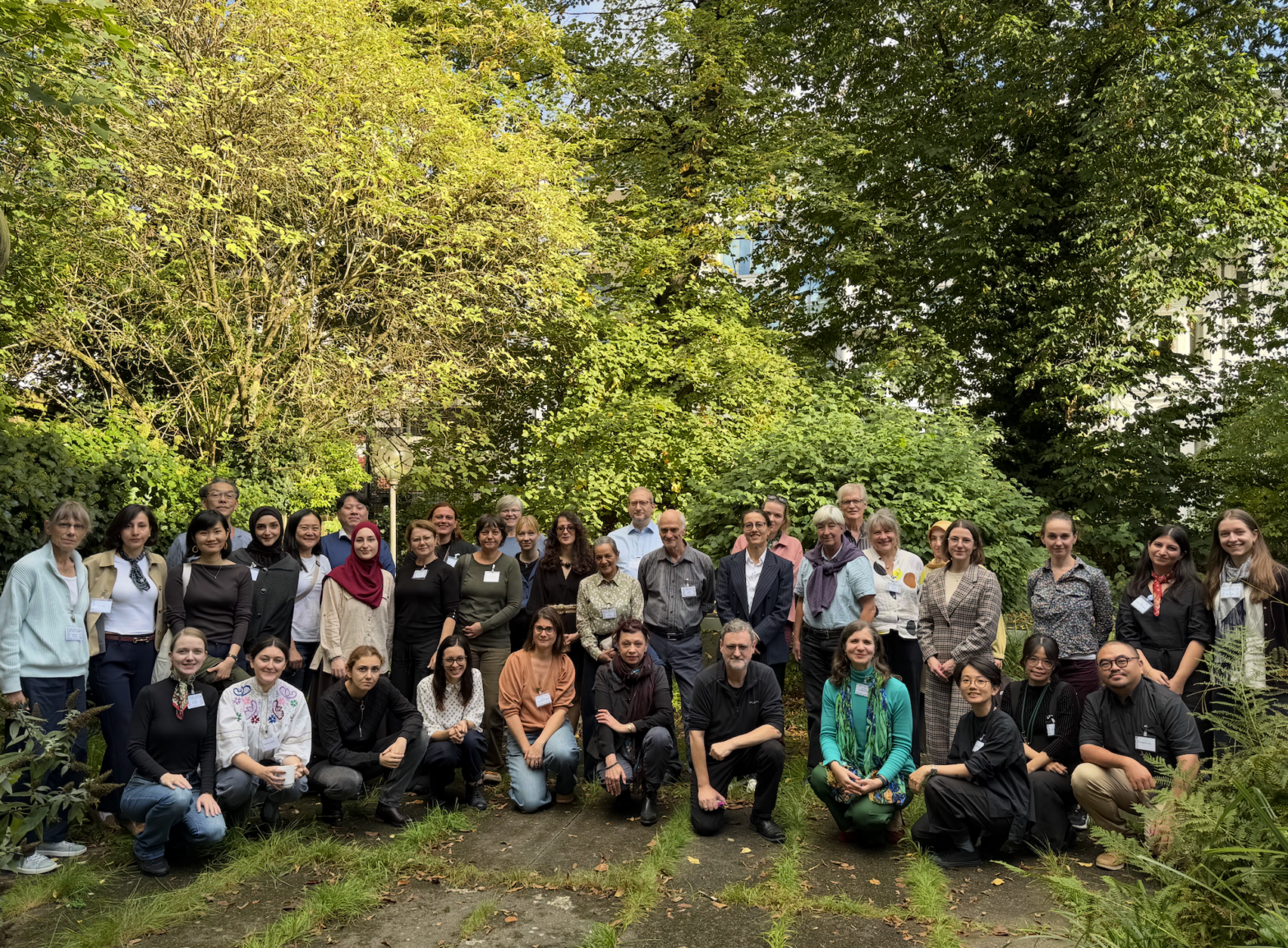
“Paper Matters” in Hamburg: Colour, Craft, and Connections across Eurasia (Day 3/3)
2 October: Living traditions, surface transformations, and collecting
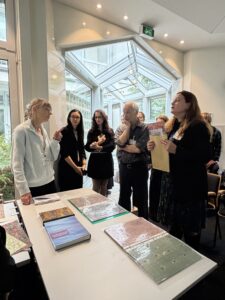
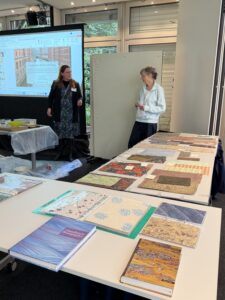
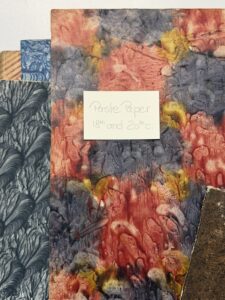
The third workshop day opened with a wonderful display of European decorated papers presented by Susanne Krause, Dr Henk Porck, and Julia Rinck, linked to the Arbeitskreis Buntpapiere. Their selection brought together marbled, sprinkled, brocade, block-printed, and stencilled papers, allowing us to compare their textures and patterns at close range. Drawing on the expertise collected in their monograph Buntpapiere, they discussed the techniques and characteristics of these varied surfaces. It was a fitting introduction to a day in which practical knowledge repeatedly enriched the study of historical objects.
Living traditions: Contemporary practice and historical techniques
Chaired by Susanne Krause, the morning panel connected the work of contemporary practitioners to the reconstruction and interpretation of historical techniques.
Around the world in 80 cuts
Esma Akoğlu, of Saray Sanat in Istanbul, introduced kaatı (katʿı), the art of cutting paper and leather, through historical and contemporary examples. She traced its twentieth-century revival through Süheyl Ünver and subsequent generations of practitioners, emphasising the transmission of knowledge through sustained practice and teaching. Her examples ranged from cut calligraphy to intricate gardens, tiny flowers and animals, and a striking sīmurgh. Both positive and negative cuts could enter compositions, while bridges held calligraphic forms together. Square rather than rounded dots in some examples made the distinction between cut and written script particularly apparent. Her practitioner’s perspective brought materials, tools, and minute construction details into focus, opening questions about the relationships between cutting, stencilling, and other crafts.
Reading the borders of the Shah Tahmasp Album
Paul Hepworth, an independent conservator in Istanbul, examined the decorated papers of the Shah Tahmasp Album, made in the late 1550s and later preserved in the Ottoman treasury. Dyed, marbled, stencilled, and gold-sprinkled papers offer evidence for its construction and its place within Safavid and Ottoman album traditions. He stressed the album’s gradual, organic growth. Changes in border decoration may reflect when artworks were incorporated, alongside choices concerning their size, shape, and thematic relationships. The borders therefore contribute directly to reconstructing the album’s history. Practical reconstruction also exposed gaps in our understanding of its makers’ craftsmanship, reinforcing the value of combining historical information, experiments, and scientific analysis.
Gold-painted margins and the preparation of gold-sprinkled paper
Anita Chowdry, of the City Literary Institute in London, approached Persian manuscript margins through the materials and techniques of painting. Her discussion distinguished shell gold from gold leaf and explored their preparation and use in European and Islamicate traditions. Looking at marginal imagery alongside practical techniques brought attention to the handling of gold, from thin washes to more substantial applications.
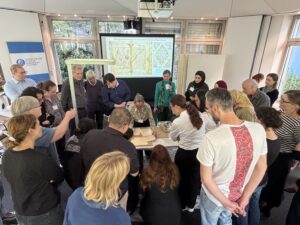
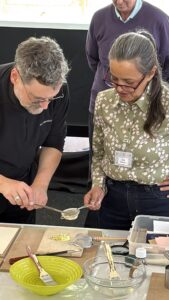
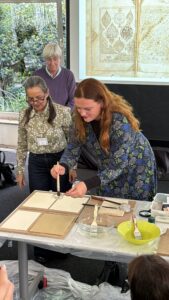
Her subsequent gold-sprinkling demonstration made these processes tangible. Gold leaf was cut and applied through a sieve with a brush onto a sized sheet. Jake also experimented with spraying diluted gold, prompting discussion of the mixture and consistency needed for successful application. Watching and trying these methods highlighted the importance of preparation, tools, and material behaviour in producing effects that can seem effortless on a finished manuscript page.
Techniques of repetition and surface transformation
The next panel, chaired by Prof Dr Nuria de Castilla, brought conservation, technical analysis, and historical recipe research into conversation.
Conserving East Asian gold-decorated papers
Prof Huan-shen Lin, of the National Yunlin University of Science and Technology in Taiwan, examined gold-decorated paper (jinhuajian) from a conservation perspective. He distinguished decoration using gold ink or leaf from embossed patterns produced through pressing, while paper samples illustrated processes such as beating, which compacts fibres and affects surface sheen. His contribution showed how classification and conservation depend on understanding the relationship between the paper and its decorative layers. Folding, moisture, and sizing can alter these delicate surfaces. Technical investigation can help characterise their materials, but treatment also requires attention to the visual and physical qualities created by their original manufacture.
A Yemeni manuscript under the microscope
Rita Capitani, of the Opificio delle Pietre Dure in Florence, presented ICRCPAL 770, a composite Yemeni manuscript whose decorated second unit was copied in 1711. Microscopy revealed larger pigment droplets applied before writing and finer decoration added afterwards on the final sheets, alongside progressively simplified frames. Scientific analysis and experiments with brushes, sponges, and a mouth atomiser helped investigate its sprayed colours and their relationship to afshān and stencilling traditions. Capitani considered simplified decoration in a devotional context, opening questions about domestic circulation, lower-cost production, material reuse, and repair. The manuscript extends discussion of these techniques into an understudied Yemeni setting, where possible Ottoman and Indian connections invite further research.
Marbling recipes and networks of knowledge
Elena Laura Jakobi, of the University of Vienna, explored how marbling knowledge circulated in seventeenth-century Europe before detailed printed instructions became widely available. A recipe manuscript in Glasgow University Library, dating to approximately 1650–65, contains four sets of marbling instructions alongside experiments concerning artificial stones and other curiosities. Comparisons with manuscripts associated with Théodore de Mayerne, his assistant Colladon, and John Evelyn revealed connections between recipes, practical experience, and personal communication. References to who had supplied particular information helped make these exchanges visible. Jakobi also connected interest in marbling to contemporary fascination with patterned stone, chance, and the imitation of nature, placing the craft within conversations spanning artistic practice and scientific curiosity.
Collection practices, conservation, and European perspectives
The final panel, chaired by Dr Henk Porck, turned to collecting, artistic authorship, and the remaking of decorated-paper objects.
Making “new” Persian folios
Prof Dr Negar Habibi, of the University of Geneva, examined Persian folios associated with the Jean Pozzi collection and their reworking for the early twentieth-century European art market. A box formerly belonging to a Parisian dealer contained manuscript leaves and hundreds of carefully cut marginal fragments, preserving evidence of deliberate dismantling and reuse. Her examples revealed how borders, calligraphic panels, and other components could be combined into convincing “new” pages. Pricking, pouncing, and collage exposed the labour involved in their reconstruction. These objects raise difficult questions about authenticity, collectors’ expectations, and the relationship between commercial necessity and creative intervention, while reminding us that a manuscript’s current appearance may owe much to its recent market history.
Carl Beitel and the Wiener Werkstätte
Marjana Uhde, of the University of Vienna, reassessed Carl Beitel (1866–1917), head of the Wiener Werkstätte’s bookbinding workshop, through 27 signed decorated papers from 1904–07 in Berlin’s Kunstbibliothek. Within the Werkstätte’s ideal of the Gesamtkunstwerk, decorated papers adorned books, boxes, and furniture, while signed and framed sheets also gained recognition as autonomous works of art. Uhde highlighted cropping as part of Beitel’s artistic process: cutting and mounting marbled sheets could transform clusters of droplets into individual compositions. Comparisons with Koloman Moser and Josef Hoffmann revealed different approaches to form and representation; Hoffmann also recalled learning marbling from Beitel. The presentation restored attention to Beitel’s craftsmanship and artistic experimentation, questioning familiar distinctions between decorative material and independent image.
European papers in a Persian album
Amélie Couvrat Desvergnes examined the so-called Nasir al-Din Shah Decoupage Album (c. 1888), whose bold borders combine cut European papers with varied central specimens, including Persian paintings, calligraphy, photographs, and lithographs. Scrolls, cartouches, roundels, and leafy forms were assembled into inventive compositions, with foliage filling gaps between larger elements. Her close examination distinguished coloured and printed papers, gold and silver papers, chromolithographs, and machine-coloured and embossed sheets imitating textiles. Marbled papers appeared only occasionally and were considered likely European imports. The album demonstrated how a diverse repertoire of imported materials could be cut, combined, and adapted within the Persian muraqqaʿ tradition, making its borders central to its artistic character.
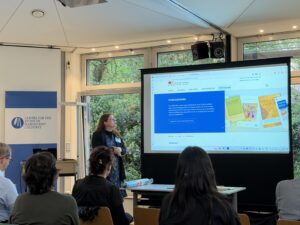
Paper matters: Continuing the conversation
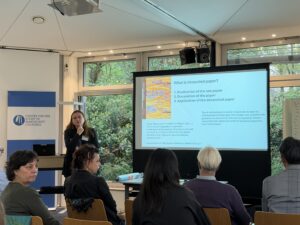
The workshop brought together objects and expertise that are often studied separately. Across the presentations, lab tours, shared viewing, and practical demonstration, a common concern emerged: how to connect what we see on a decorated surface to its materials, making, movement, and later transformation.
The closing discussion returned to a question raised at the outset: what do we mean by decorated paper? Susanne Krause emphasised the need for a shared definition that supports global comparison while respecting the specific terminology used in European and Islamicate traditions. Questions about tinting, colouring, and paper preparation highlighted the importance of distinguishing between the production of raw paper, its subsequent decoration, and the use of the decorated sheet.
For GLOBAL DECO PAPER, these exchanges offer valuable directions for future comparisons and collaborations. The conversation will continue beyond Hamburg: a publication arising from the workshop is planned – stay tuned!
We warmly thank the speakers, chairs, and practitioners for sharing their knowledge and making these conversations possible. Many thanks also to the CSMC team for their support and for hosting the event!