
“Paper Matters” in Hamburg: Colour, Craft, and Connections across Eurasia (Day 2/3)
1 October: Introducing decorated paper
Prof Dr Kaja Harter-Uibopuu opened the first full presentation day by introducing the CSMC and the Cluster of Excellence Understanding Written Artefacts. Our PI, Prof Dr Ilse Sturkenboom, then considered the definition of decorated paper. Whether brightly coloured or barely perceptible, applied before writing or during refurbishment, decoration invites examination of both the surface’s making and its place within the larger object.
Objects in motion: Anthologies and alba amicorum
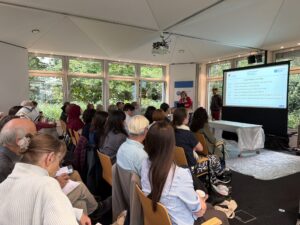
The morning panel, chaired by R. B. Davidson MacLaren, explored decorated papers in manuscripts and networks of exchange.
An enigmatic Timurid anthology at the Metropolitan Museum of Art
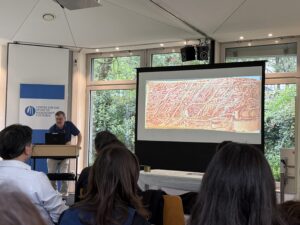
Yana van Dyke and Dr Jake Benson presented their investigation of MET 1997.71, an oblong safīna probably completed in Herat by Sulṭān Muḥammad Nūr in 1499–1500. Its tinted sheets combine finely sprayed, mirrored birds, animals, and winged figures with irregular “proto-marbled” rivulets. Jake demonstrated a possible technique using an antique Chinese laundry sprayer, while Yana discussed Hirox imaging and analysis of folium, a colourant producing blue and purple hues. Their study connects material evidence, textual structure, and displaced or missing leaves to reconstruct the manuscript’s making and later history.
Collating a life: The material construction of alba amicorum
Prof Dr Marika Keblusek, of Leiden University, examined decorated papers in European friendship albums, focusing on physician and collector Bernardus Paludanus’s (1550–1633) album, MS 133 M 63 in the National Library in The Hague. Marbled sheets and smaller interleaved papers reveal choices made during assembly. Many albums were bound only after active use had ended, marking a final stage in an extended collecting process. A French watermark in one marbled sheet also suggested European manufacture alongside imported supplies.
The German House and Eurasian decorated papers
Prof Dr Robyn Radway, of the Central European University in Vienna, traced decorated papers from the German House, the Habsburg diplomatic outpost in Ottoman Constantinople, into Central European friendship albums. From the late 1560s, travellers and staff acquired marbled, silhouetted, and sprinkled sheets, which also reached consumers who had never visited the Ottoman Empire. Robyn highlighted women’s early participation and the expansion beyond court-connected elites. Calligraphy, heraldry, and changes in paper orientation showed how consumers adapted these materials to individual books.
Looking together: Caspar von Abschatz’s album
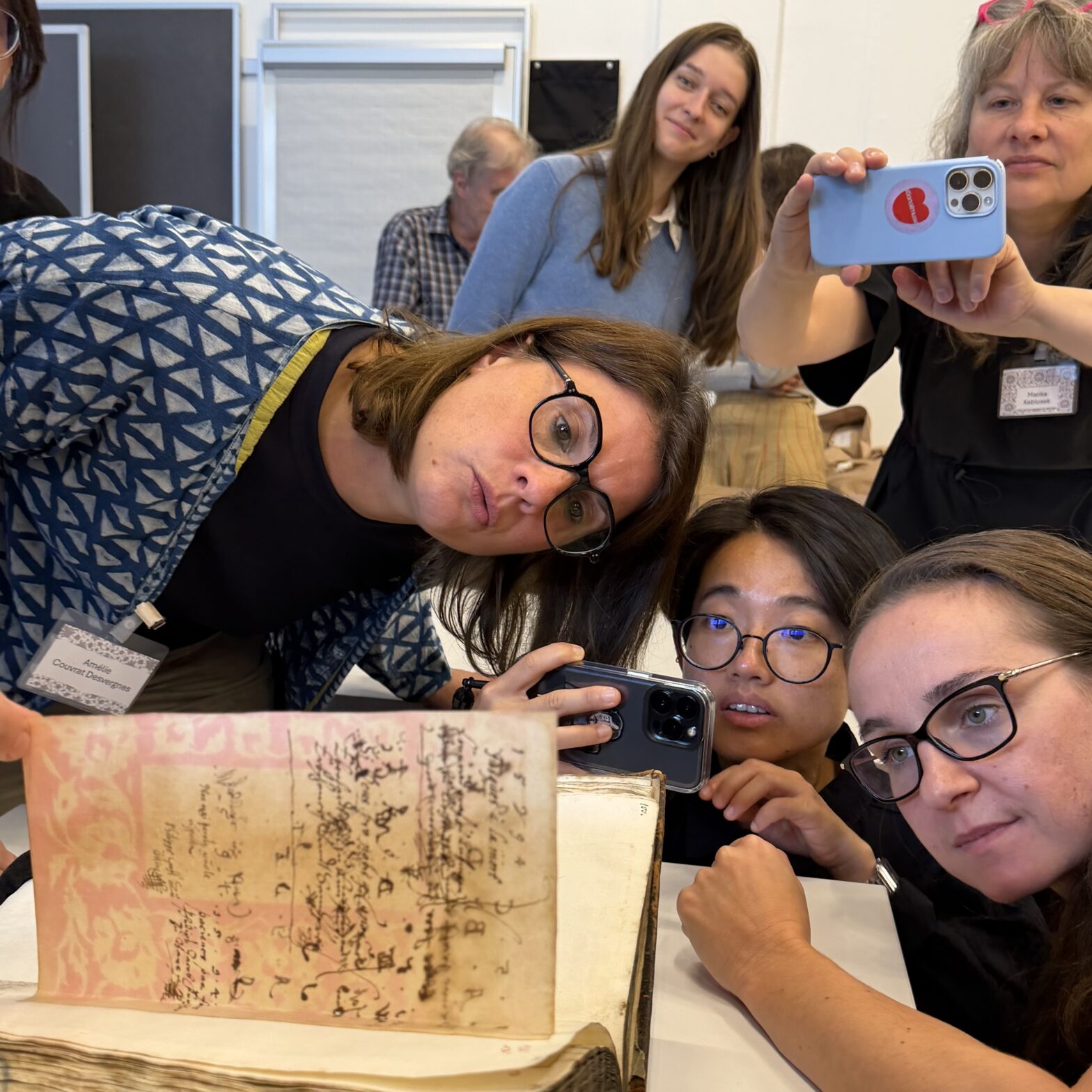
At the State and University Library Hamburg, Dr Anne Liewert introduced Caspar von Abschatz’s album amicorum, Cod. in scrinio 198a. Shared examination prompted questions about paper supplies, binding, and later alterations. Marbling comparable to the Turkish battal type sparked discussion of additives that might explain large uncoloured areas. Rough metallic-looking surfaces and marks transferred to facing pages prompted suggestions for future XRF analysis, showing how shared observation can generate new research questions.
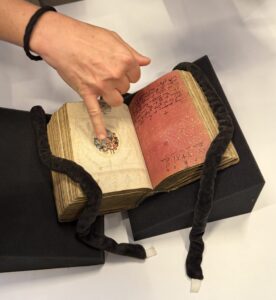
Constructing the decorated surface
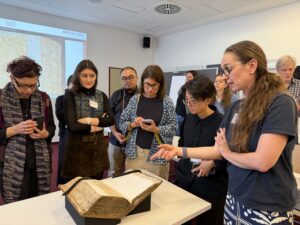
The afternoon panel, chaired by Prof Dr Uta Lauer, examined the making of Ottoman album pages, Chinese embossed papers, and Bukharan manuscript margins.
Paper joinery in the albums of Qalandar Pāshā
Dr Nil Baydar, of the Manuscripts Institution of Türkiye, explored Qalandar Pāshā’s albums, particularly the Album of Sultan Aḥmad I, Topkapı Palace Museum Library B.408. As a vaṣṣāl, or paper joiner, Qalandar combined coloured papers, cut ornaments, stencilling, gilding, and borders into composite pages. Close examination revealed assembly sequences, concealed seams, and carefully aligned decoration. Recurring solutions across albums demonstrated how page construction preserves evidence of workshop practice and skilled labour.
Recovering the hidden patterns of Song paper
Dr Yan-chiuan He, of the National Palace Museum in Taiwan, showed how subtle embossed patterns on Song-dynasty papers can escape recognition. Investigation of Huang Tingjian’s Poem on the Hall of Pines and Wind and other works helped identify more than twenty further examples. Oblique photography and digital processing revealed geometric patterns, birds, vines, textile-like textures, and landscapes, contributing to the museum’s 2018 exhibition and catalogue. Their concentration in works associated with Su Shi’s literary circle suggests shared preferences, while later processing and remounting help explain their reduced visibility.
Mosaics in paper: Bukharan manuscript margins
Dr Jaimee Comstock-Skipp, of the University of Oxford, examined manuscripts of Jāmī’s Yūsuf and Zulaykhā made in 1570s–80s Bukhara. Standardised features and the absence of identifiable royal patrons suggested substantial commercial production, possibly including export to India. Coloured papers, stencilled or traced designs, and applied cartouches and medallions enriched the margins and could enhance market value. Losses revealed their “mosaic” construction. Jaimee connected this recognisable Bukharan appearance to regional identity, spiritual networks, and buyers’ expectations, while considering later modifications.
A survey of GLOBAL DECO PAPER
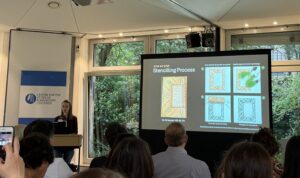
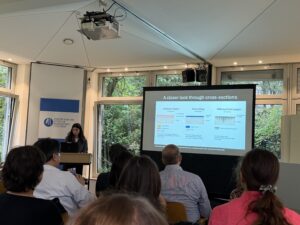
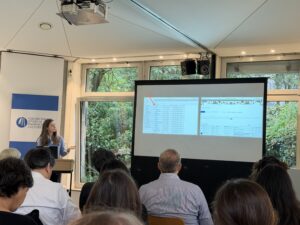
The day concluded with a presentation by our GLOBAL DECO PAPER team at LMU Munich: Ilse introduced the project, and Yih-chuen explored Chinese decorated papers. Ilse then discussed their incorporation into fifteenth-century Persianate manuscripts and possible processes of adaptation and imitation. Theresa and Negar compared stencilling and silhouetting, examining how visually similar results can arise through distinct techniques and what material evidence can help distinguish them. Lily demonstrated pattern tracing in Affinity Photo and introduced the project database and website. Tracing supports the reconstruction and comparison of designs across dispersed collections, while requiring careful decisions about uncertain details. Hanieh presented her doctoral research on AI-assisted analysis, particularly of stencilling, through a human-in-the-loop workflow that keeps specialist review central to selection, annotation, comparison, and interpretation. Together, these contributions showed how close examination, practical reconstruction, and digital methods inform one another in our research into decorated papers and their circulation.
Stay tuned for the last workshop day!