
From Central and South Asian Stencilled Manuscripts to the Bohra Khizānā
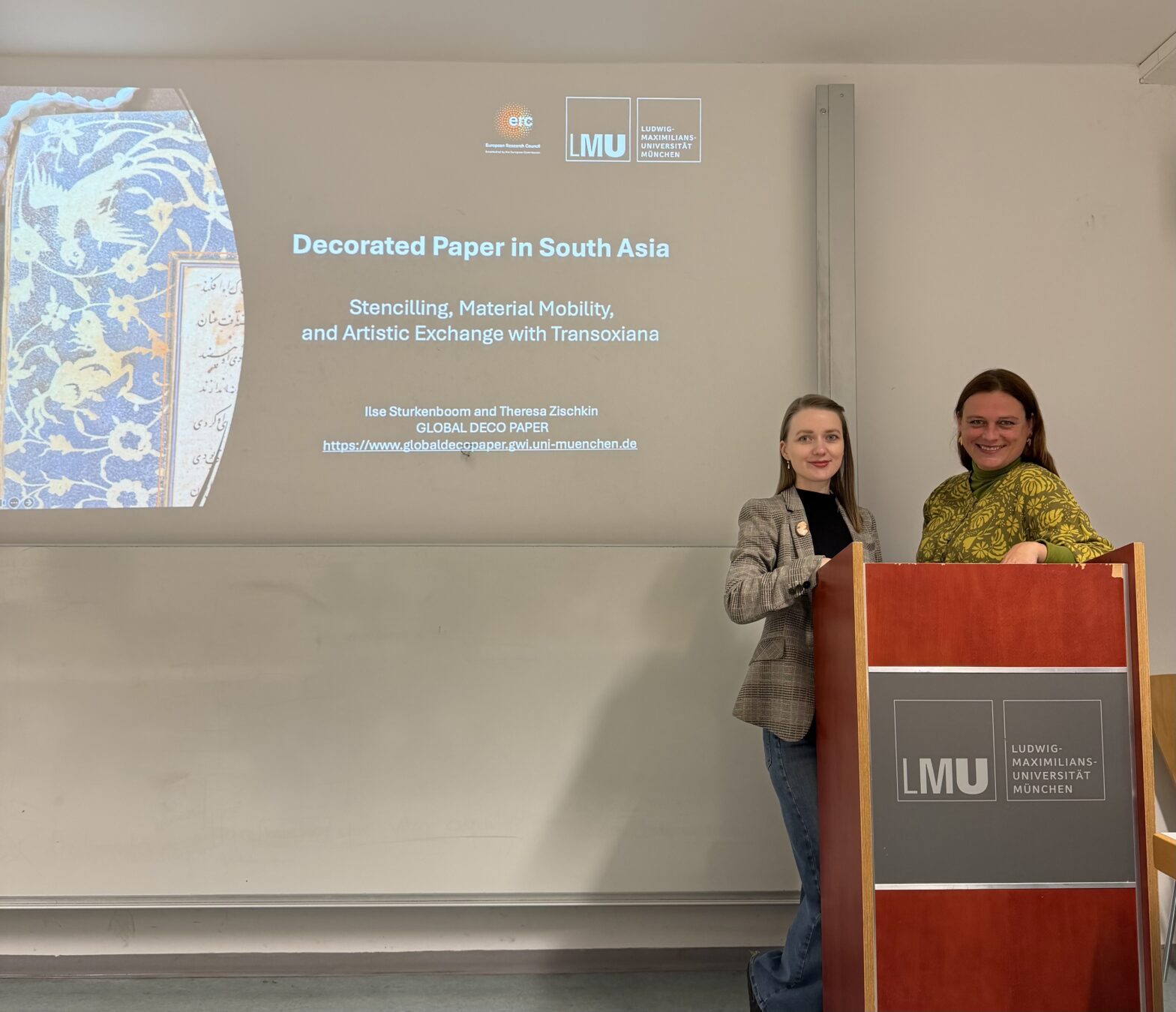
On 3 November 2026, Ilse Sturkenboom and Theresa Zischkin presented their research on decorated paper at the Lecture Series and Colloquium in Indology, Tibetology and Buddhist Studies at LMU Munich. Their lecture, entitled “Decorated Paper in South Asia: Stencilling, Material Mobility, and Artistic Exchange with Transoxiana,” explored the artistic and material connections between the Mughal Empire and Central Asia.
Ilse and Theresa first explored Mughal gardens, architecture, and book painting, highlighting the ways in which Mughal artistic culture drew inspiration from the Timurid past. This enduring nostalgia for Timurid culture provided a fascinating starting point for examining the connections between the Mughal Empire and Central Asia, as well as the movement of artistic practices, materials, and ideas across these regions.
The lecture then turned to the central research focus of GLOBAL DECO PAPER: decorated paper in early modern manuscripts. Ilse introduced a group of Central Asian manuscripts featuring distinctive stencilled designs. These decorated papers display a fascinating range of floral, geometric, and zoomorphic motifs, arranged in both positive and negative forms. The recurrence of identical designs across different manuscripts raises intriguing questions about specialised workshops, the circulation of materials, and the transmission of decorative techniques.
Building on this introduction, Theresa presented several case studies of manuscripts connected to, and decorated in, the Indian subcontinent. She discussed the challenges of dating and localising stencilled paper, particularly when the decorated frames were added at a different time from the calligraphed text. Through the examination of ownership inscriptions, seals, illumination, illustration, and other codicological evidence, the presentation explored how manuscripts can reveal traces of either movement between or inspiration drawing from Central and South Asia.
Particular attention was given to the role of Jāmī, the celebrated Persian poet and Naqshbandī Sufi, and the importance of Naqshbandī networks in connecting Central and South Asia. These networks, alongside Mughal appreciation of Timurid artistic heritage, offer valuable perspectives on the circulation and valuation of manuscripts and their materials. The case studies raised important questions about whether stencilled decoration formed part of a manuscript’s original conception or was introduced through later interventions.
The lecture demonstrated how decorated paper can provide new insights into artistic exchange, material mobility, and manuscript practices across the wider Islamicate world. By looking beyond the written and illustrated text to the decorated surfaces surrounding it, the project seeks to illuminate an often-overlooked dimension of early modern manuscript culture. The presentation was met with many excellent questions from the audience, leading to a lively and stimulating discussion. We were delighted by the interest in our research and the opportunity to exchange ideas with colleagues working on South Asian art and manuscript traditions.
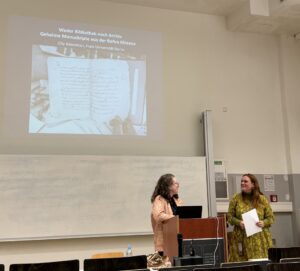
The evening continued immediately afterwards with another fascinating contribution to the study of manuscript cultures. Ilse had invited her colleague Dr Olly Akkerman (Freie Universität Berlin) to give a lecture as part of the 4MZ Basiswissen Islam series. His talk, entitled “Neither Library nor Archive: Secret Manuscripts from the Bohra Khizānā” offered a rare opportunity to learn more about the Khizānā, a remarkable and secretive manuscript collection associated with the Bohra community.
Dr Akkerman’s presentation opened up new perspectives on this fascinating collection and provided valuable insights into the Bohra community, its manuscript traditions, and the distinctive nature of its textual heritage. It was a wonderful opportunity to learn about a collection that remains relatively little known and to explore the questions it raises about the preservation, organisation, and transmission of manuscripts.
Together, the two lectures made for a particularly rewarding evening at LMU Munich. From stencilled papers connecting the Mughal Empire with Central Asia to the intriguing manuscript traditions of the Bohra Khizānā, the discussions highlighted the richness and diversity of manuscript cultures across the Islamicate world.
We are grateful to everyone who joined us, asked thoughtful questions, and contributed to the lively discussions. It was a wonderful evening filled with stimulating conversations, new perspectives, and shared enthusiasm for the study of manuscripts and their material histories!