
New York City, March–April 2026: Part I
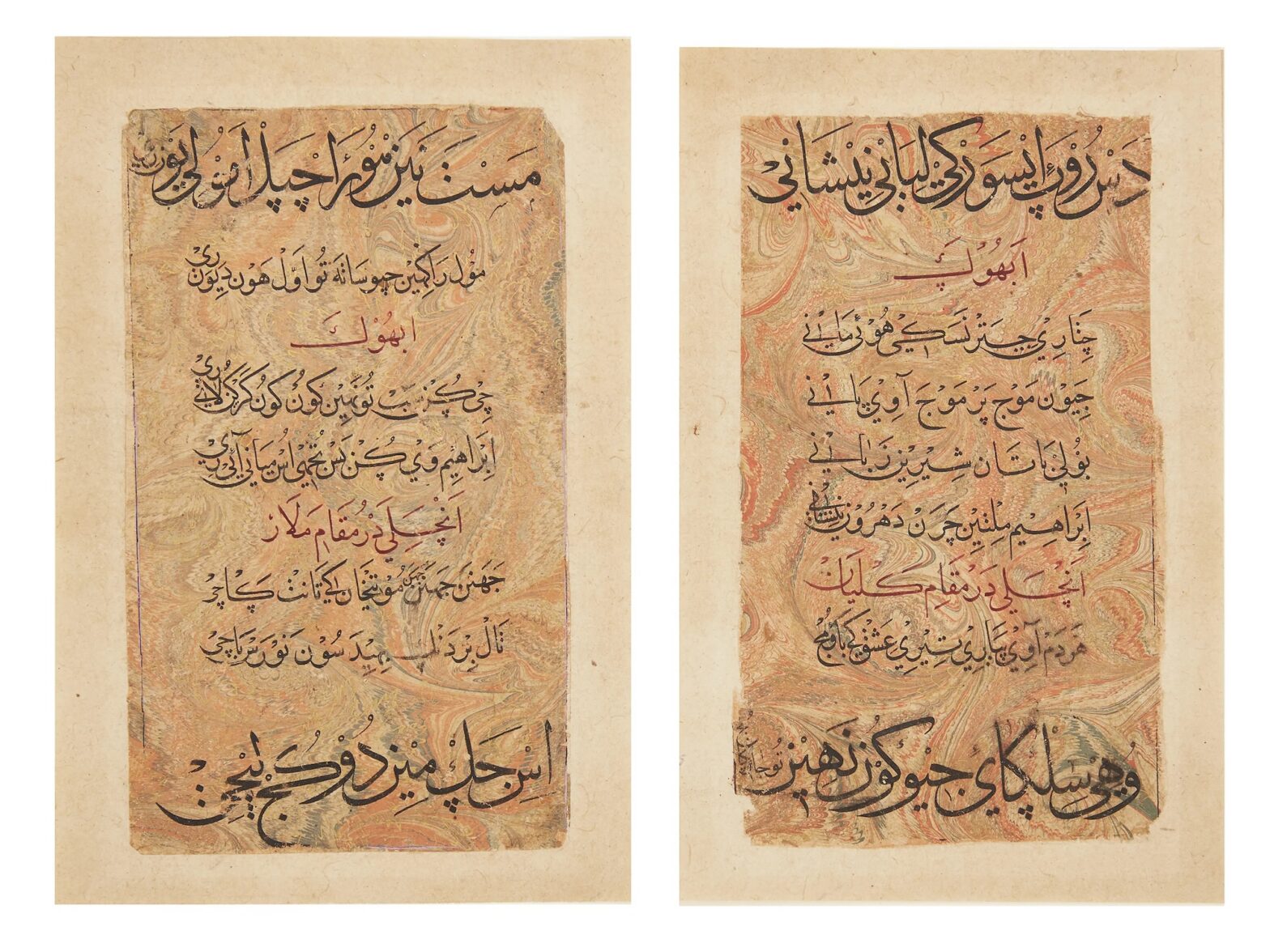
This spring, Dr. Jake Benson examined manuscripts and single folios held in the Metropolitan Museum of Art, the New York Public Library, and the Brooklyn Museum of Art. This post discusses a pair of consecutive, split pages detached from a manuscript of the Kitab-i Nauras (Book of ‘Nine Tastes’ or ‘Newly Arrived’) which was sold at Roseberys’ London in 2023, then subsequently acquired by the Metropolitan.
The Deccan Sultanate ruler of Bijapur, Ībrahīm ‘Ādil Shāh II (b. 1570, r. 1580–1626) first composed this compilation of his original Dakhni Urdu poems and songs in circa 1005–1007 AH (1597–1599 CE). In his edition and analysis of the work published in 1956, Nazir Ahmad delineates how production of the surviving manuscripts probably commenced around 1012 AH (1603 CE). In this case, the calligrapher selected a very fine combed and curled marbled papers for the manuscript.
The designs on the two folios appear similar and made by the same marbler, however, the patterns in the gutter margins do not comport. Hence they constitute consecutive pages, but whether a dealer or collector split a single page apart and mounted them or if they bear the preceding and subsequent lines on the reverse awaits verification. If the former, then the calligrapher originally selected stock marbled and decorated on both sides of the sheet. To form the intricate designs, a marbler first expertly prepared colourants and a mucilage, which surviving sources indicate derived from fenugreek seed. A special dispersant added to the colours enabled them to float without mixing. In this case, surviving sources suggest it marblers employed a compound of chemical saponins derived from species of Sapindus (soapberry) nuts, and aleuritic acids derived from lac resin, further saponified with borax to make it miscible. This formulation enveloped colourant particles in surfactant micelles which forced droplets to spread equidistantly upon the liquid surface; however, the viscosity of the underlying mucilage restricted any free movement. This allowed the marblers to repeatedly divide the colours with a stylus in back-and-forth motions both vertically and horizontally several times, to form long, smoothly-formed striated chevron designs which reflect scientific principles of laminar flow. After forming this initial pattern, the marbler then placed a fine-toothed comb at one end of the design and then slowly drew it over the colours, tiny arcs. In this case, the comb appears so extremely fine, with teeth placed less than 1 mm apart, the density would sometimes push, rather than divide, the colours. When this occurred, the marbler lifted the comb up to relieve the pressure, then repositioned the comb, and resumed carefully drawing it over the colours, which resulted in noticeable skips in the pattern.
Lastly, the marbler placed a sheet of paper, probably mordanted with alum and dried beforehand. Future blog posts will feature Deccani single-page, depictive marbled artworks that utilize these unusual ‘skipped’ pattern features. An unidentified calligrapher wrote the lines in thuluth with large bands at top and bottom and small lines in the middle, a format comports with a majority of surviving manuscripts analyzed by Ahmad. However, in this case, the order notably differs from Ahmad’s edition, for it commences on the right with the six lines of Song 16, followed by Song 33, then concludes with the first lines of Song 27, hence they read as follows, beginning on the right, as translated by Ahmad:
[Song 16, lines 9–14]
A successful painter like Mani would fail to draw her picture.
How is it possible to paint the picture of flowing water?
She is chatting very attractively.
Ibrahim would readily place his forehead on her feet.
[Song 33, lines 1–4]
Song in the Maqam of Kalyān.
O my darling, all the time I am feeling the breeze of your love and only that
would keep the candle of soul burning which would otherwise be extinguished.
[Left: Song 33 con’t., lines 6–10] Your intoxicated and playful eyes arc so invaluable
that I am prepared to purchase them even at the cost of my life.
You possess unusual abilities.
From whom have you learnt all this?
A person of your qualities cannot be pointed out.
[Song 27, lines 1–3, 5]
Song in the Maqam of Malāz.
‘When Moti Khan* is being played upon,
it produces varieties of musical notes.
The most desirable things in the world
are a tanbur and a beautiful lady.
[* Ībrāhīm’s tanbur stringed instrument]
While unsigned, the hand closely resembles what Ahmad deemed the earliest surviving, nearly complete copy of the work. Completed by ‘Abd al-Laṭīf Muṣṭafà, which a note records how the ‘Ādilshāhī royal library subsequently accessioned it on 5 Muharram 1022 AH (25 February 1613 CE). This same scribe also signed calligraphy specimens mounted in the Muraqqa‘-i ‘Ādilshāhī completed for Ībrāhīm’s son and successor Muḥammad ‘Ādil Shāh (b. 1612 r. 1627–1656), including one dated the same year (Hyderabad, Salar Jung Museum M.91, f. 15/p. 29). That album also preserves specimens by him spanning that year to 1033 AH (1623–1624 CE) with the epithet ‘Majlisī’ (Assemblyman), indicative of his courtly status. It also preserves specimens primarily in naskh and thuluth scripts on various paper types and mounted a range of similarly finely combed and patterned marbled papers, including several signed by ‘Abd al-Ḥalīm bin Muṣṭafà, whom Ahmad describes as ‘Abd al- Laṭīf’s son, and another scribe ‘Abd al-Rashīd Ībrāhīmshāhī, whose final niṣba indicates his appointment as court calligrapher during Ībrahīm’s reign.
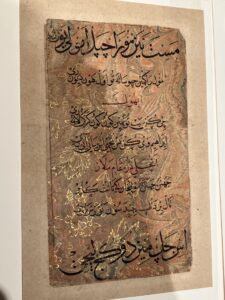
writing. Metropolitan Museum of Art, 2025.580.2.
The scribe not only selected intricate marbled paper, but one further and illuminated with bold floral scrollwork designs executed in gold ink, visible when tilted at an angle. That reflects considerable time, effort, and expense expended to create the paper for this manuscript, hence it was one probably prepared for Ībrāhīm personally, akin to other surviving copies analyzed by Ahmad.
Ironically, the intricately combed and curled marbled pattern closely resembles to another folio detached from a different Kitab-i Nauras manuscript, now held in the Cleveland Museum of Art (2013.330b, Online: https://www.clevelandart.org/art/2013.330.b). However, compared to the Metropolitan folios, that scribe wrote the lines in flowingnasta‘liq script. Iranian calligraphy expert Hamidreza Ghelichkhani compares the hand to other examples completed by Safavid émigré to Bijapur, Khalīlallāh known as ‘But-Shikan (Idol-breaker). Appointed royal calligrapher, Ībrāhīm bestowed the epithet Bādshāh-i Qalam (Padishah of the Pen) upon him after completing a superb copy of the Kitāb-i Nauras. Despite their fragmentary condition, these detached folios of poems and songs by Bijapur’s ruler reinforce to an already burgeoning body of evidence indicating that marbled patterning advancements—a ‘second wave’ of the art—probably occurred there by circa 1600 during Ībrāhīm’s reign.
Further examples of marbling in an album primarily held in the University of Edinburgh Library (Or. Ms. 373), which contains a preface praising another Safavid émigré to the Deccan, a marbler named Muḥammad Ṭāhir, together with two missives addressed to the same artist, one dated by a chronogram to 1008 AH (1600–1601 CE), indicate that he attained these achievements by that time. While prior studies of the album suggested a potential Bijapuri provenance, this new evidence not only reinforces that attribution, but also by extension, one for the innovation of combed patterning methods in paper marbling.
A big thank you goes to the MET team for their support during the research.
Sources:
Nazir Ahmad, Kitab-i-Nauras by Ibrahim Adil Shah II (New Delhi: Caxton Press, 1956), pp. 36, 38–39, 80–86 [manuscripts], 105–106, 110, 113 [text], 135, 138, 140 [translation].
Jake Benson, ‘The Art of Abri: Marbled Album leaves, Drawings and Paintings of the Deccan’ Sultans of Deccan India, 1500–1700: Opulence and Fantasy, ed. Navina N. Haidar and Marika Sardar (New Haven: Yale University Press, 2013), pp. 157–159.
_____. ‘The Qita‘at-i Khush Khatt Album: Authenticity and Provenance’, in Iran and the Deccan: Persianate Art, Culture, and Talent in Circulation, ca. 1400–1700, ed. Keelan Overton (Bloomington: Indiana University Press, 2020), pp. 337–365.
Hamidreza Ghelichkhani, ‘Khalilullah “Padishah of the Pen”: Royal Scribe and Ambassador of Shah ‘Abbas and Ibrahim‘Adil Shah II,’ trans. Kimia Maleki and Jake Benson, in Iran and the Deccan: Persianate Art, Culture, and Talent in Circulation, 1400–1700, ed. Keelan Overton (Bloomington: Indiana University Press, 2020), pp. 367–400.
Navina N. Haidar and Marika Sardar, Sultans of Deccan India, 1500–1700: Opulence and Fantasy (New Haven: Yale University Press, 2013), p. 120–122, Nº 45.
Sunil Sharma, ‘Forging a Canon of Dakhni Literature: Translations and Retellings from Persian’, in Iran and the Deccan:Persianate Art, Culture, and Talent in Circulation, 1400–1700, ed. Keelan Overton (Bloomington: Indiana University Press, 2020), p. 405, 415 n21.
Sonja Quintanilla et al., Mughal Painting: Art and Stories (Cleveland: Cleveland Museum ofArt, 2016), p. 246, no. 66, fig. 4.96.
Rosebery’s London, Antiquities, Islamic & Indian Arts (28 April 2023), lot 312. Online <https://www.roseberys.co.uk/bidding/A0591-antiquities-islamic-indian-arts-467/312-two-folios-from-a-copy-of-the-kitab-i-navras-the-book-of-540087>.