
GLOBAL DECO PAPER at the 15th Biennial Iranian Studies Conference in Utrecht
The GLOBAL DECO PAPER team recently participated in the 15th Biennial Iranian Studies Conference, hosted by the Association for Iranian Studies in Utrecht, the Netherlands. Across four days of presentations and discussions, the conference offered valuable opportunities to connect our research on decorated paper with wider questions of manuscript circulation, collecting, compilation, and the movement of artistic techniques across the Persianate world.

The conference began with registration in Utrecht’s Domkerk, followed by an opening ceremony at the University Museum. During the reception in the museum garden, we reconnected with long-standing colleagues and met others in person for the first time. A particularly stimulating conversation with Canadian colleagues opened up new perspectives on manuscript collections and possible future research opportunities in Toronto.
Manuscripts in Circulation
Of particular relevance to our project was the panel “Histories of Circulation: People, Books, and Ideas between Iran and India (1500–1800),” chaired by Mahdieh Tavakol. The papers approached manuscripts as material anchors of mobility, devotion, and intellectual exchange, showing how Persianate culture was constituted through the movement of people, texts, and objects between Iran and India. Mana Kia examined how manuscript circulation was represented in eighteenth-century tazkirahs and how political upheaval and imperial fragmentation transformed both transregional networks and the cultural memory of such movement. Mahdieh Tavakol focused on manuscript endowments made by Iranian émigrés in India to religious and educational institutions in Safavid Iran. These books functioned simultaneously as pious offerings and as instruments of intellectual connectivity.
The panel closely intersected with the concerns of GLOBAL DECO PAPER. Decorated papers, motifs, and production techniques travelled within the same networks of patrons, scholars, artists, collectors, and institutions that enabled manuscripts to circulate. Studying the movement of books can therefore help us understand how decorated paper technologies were transferred and adapted across Greater Iran, Central Asia, and South Asia.
Collections and Access
The panel “Iranian Art and Material Culture in Switzerland: Toward a New Perspective” drew attention to substantial but still insufficiently studied collections in Zurich and Geneva. Negar Habibi discussed nearly 2,000 Iranian and Persianate objects preserved across Geneva’s major institutions, while Quentin Arnoux examined the approximately 600 Persian artworks in the Musée d’Art et d’Histoire and the challenges of making them more accessible to researchers and the public.
For GLOBAL DECO PAPER, the session reinforced the importance of approaching collections as research infrastructures. Decorated papers are frequently overlooked in catalogues, subsumed under general manuscript descriptions, or preserved within albums and groups of detached folios. Collaboration with curators and closer examination of collections may therefore reveal previously unidentified examples and expand the known geography of particular techniques.
Sensuous Sheets: The GLOBAL DECO PAPER Panel
Our panel was chaired by Ilse Sturkenboom and brought together four papers on printed, stencilled, silhouetted, and marbled papers across Chinese, Islamicate, and European manuscript cultures. Together, the presentations demonstrated that decorated papers were not merely incidental embellishments, but technologies that transformed manuscript production, visual experience, and the circulation of designs.
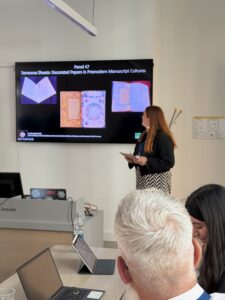

Ilse Sturkenboom opened the panel with “Meanings of ‘Chinese’ Paper in Timurid-Era Manuscripts and in Ming China,” presenting research co-authored with Yih-chuen Liao. The paper examined colourful and glossy sheets decorated with printed gold motifs and gold flecking that were used in select Timurid and Turkman manuscripts. Fibre analysis, original sheet dimensions, and the use of woodblock printing point towards an East Asian origin. By comparing their use in Persianate manuscripts and Ming handscrolls, the presentation explored how these papers acquired different meanings in distinct cultural settings. In Timurid and Turkman contexts, they could evoke rarity, royalty, mysticism, and foreignness, while their use in Ming China raised further questions about courtly consumption, diplomatic exchange, and possible production for export.

Theresa Zischkin’s paper, “Motifs in Motion: Stencilled Designs in Persianate Manuscripts,” traced stencilled decoration from the fifteenth to the eighteenth century across Greater Iran, Central Asia, and South Asia. Beginning with the so-called Yazd Anthology and culminating in manuscripts refurbished in the atelier of the Mughal nobleman ʿAbd al-Raḥīm Khān-i Khānān, the paper demonstrated the variety and flexibility of stencilling within Persianate book production. Vegetal scrolls, geometric repeats, animals, and figures were mirrored, repeated, recombined, and varied through colour. Stencilling therefore served not only as a means of efficient replication, but also as a method of modular design and aesthetic experimentation. The paper further considered how repeatable tools, workshop knowledge, and methods of application could travel alongside or independently of completed manuscripts, allowing motifs to be adapted to new regional and artistic settings.
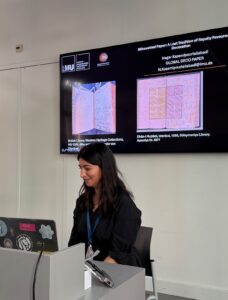
Negar Kazemipourleilabadi presented “Silhouetted Paper: A Lost Tradition of Royally Favoured Decoration.” Her paper examined a distinctive Ottoman practice that reached particular refinement in sixteenth-century Istanbul and was closely associated with the imperial atelier. Through codicological case studies, she considered positive and negative designs, floral and zoomorphic motifs, colour palettes, and the varied terminology used to describe the technique. The uncertainty surrounding its precise production process demonstrates the value of combining manuscript examination, technical reconstruction, and comparative study. Its presence in Ottoman and European collections also reveals how a paper technology could contribute to a specifically Ottoman courtly aesthetic while participating in broader histories of circulation and collecting.
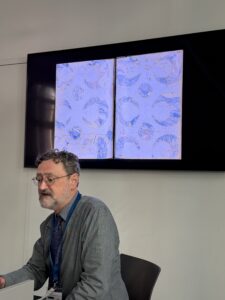
Jake Benson concluded the panel with “Turco-Persian Masked Marbling and Its Impact.” Moving from Ottoman examples to advanced marbling traditions in the Deccan and later European adaptations, the paper explored how paper cut-outs and fluid resists were used to create blank reserves within marbled sheets. In the Deccan, these processes were employed to produce writing papers, prefabricated books, album mounts, and complex visual imagery. Masked marbling later entered European contexts and was eventually used as a security device on currency and other financial documents. The paper thus demonstrated how a manuscript-related technique could migrate into new media, regions, and economic functions.
We were delighted by the attentive audience and the thoughtful questions and suggestions that followed the presentations. The discussion confirmed the value of studying these techniques comparatively. Although printed, stencilled, silhouetted, and marbled papers developed in different environments, they all involved transferable knowledge, repeated forms, material experimentation, and close coordination between the sheet and the wider manuscript.
The day concluded with a musical interlude and Christine van Ruymbeke’s inspiring keynote lecture, “Changes, Challenges and Opportunities: Persian Literary Studies in This Second Quarter of the 21st Century.”
Lithographic Manuscripts
Particularly relevant to our own interests was the panel “The Afterlife of Saʿdi Shirazi’s Legacy in the Persianate World: Print Culture in the 19th and Early 20th Centuries.” The papers examined how works such as the Gulistān continued to circulate and acquire new material forms through nineteenth-century print culture, especially lithography. Roxana Zenhari highlighted the close relationship between lithographic books and earlier manuscript traditions: layouts could retain central text panels, surrounding marginal columns, illumination-like elements, and extensive illustration, while individual volumes sometimes combined several works within a single codex. Lithographic editions produced in centres such as Tehran, Tabriz, Lucknow, and Bombay could subsequently circulate as far as Tashkent and Samarqand, demonstrating the continued mobility of Persian literary and visual traditions across political and regional boundaries. Hasan Hameed likewise emphasized that the transition to print did not simply replace manuscript culture; lithographed editions could preserve a distinct visual and commentarial language inherited from earlier forms of book production.
These examples offer an intriguing perspective on the longer afterlives of manuscript aesthetics. Lithography can be considered as an intermediate material and visual stage between handwritten manuscripts and later forms of print, raising questions about which features of decorated paper, page layout, marginal organization, and manuscript design remained meaningful enough to be reproduced in a new technology. Particularly interesting is the evidence for lithographic books that continued to evoke decorated manuscripts. Looking beyond the chronological boundaries of our project could therefore help us consider not only how decorated papers circulated in the premodern period, but also how their visual conventions were remembered, translated, or transformed once the technologies of book production themselves began to change.
Compilations, Reuse, and Manuscript Assembly
Another session with strong relevance to the project was “New Approaches to the Persian Majmūʿa(s) and Jung(s),”chaired by Mahroo Moosavi. The panel examined compilations containing poetry, prose, letters, decrees, paintings, diagrams, and other materials. Rather than treating these books as miscellaneous accumulations, the speakers investigated the intellectual and material decisions through which they were assembled. Mahroo Moosavi focused on Staatsbibliothek zu Berlin MS. or. fol. 209, a monumental compilation completed in Qazvin in 1666. Its elaborate table of contents and an introductory note stressing the careful planning of the volume reveal the agency of its commissioner and compiler. Margaret Shortle examined landscapes and other nature imagery in medieval anthologies, asking how the juxtaposition of visual and textual fragments could evoke movement, memory, and imagined spaces. Gennady Kurin discussed late Safavid majmūʿas as pedagogical archives in which the careful arrangement of letters, edicts, and exemplary narratives served the moral and political education of princes and scribes.
The session offered an important methodological reminder for GLOBAL DECO PAPER. Decorated sheets must be studied not only in relation to their original production, but also according to how they were later selected, cut, rearranged, refurbished, and integrated into new books. Compilation and reuse could transform the appearance and meaning of a decorated page as decisively as its initial creation.

New Directions for the Project
The conference demonstrated how closely the study of decorated paper is connected to broader questions in Iranian and Persianate studies. Paper techniques cannot be reconstructed through material examination alone. They must also be understood through the circulation of manuscripts, the movement of artists and patrons, the formation of collections, and repeated processes of compilation, reuse, and refurbishment.
We left Utrecht with fresh research questions, new contacts, and promising possibilities for future collaboration. We warmly thank the organizers for bringing together such a diverse scholarly community, as well as everyone who attended our panel, contributed to the discussion, and shared suggestions for the continued development of our research.