Rethinking Images in Strasbourg: New Questions for GLOBAL DECO PAPER
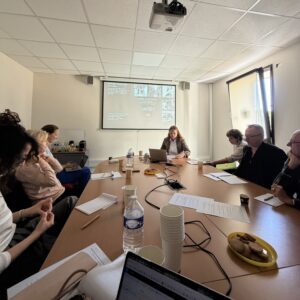
On 22 September, Ilse Sturkenboom, Hanieh Arjomand-Fard and Theresa Zischkin took part in the one-day workshop Rethinking the Image in Islam and in Islamic Societies: Challenges, Methods and Perspectives in Strasbourg. Convened by Nourane Ben Azzouna, Associate Professor at the University of Strasbourg, the workshop brought together approaches to images ranging from close study of manuscripts to anthropology and art-historical theory. For our GLOBAL DECO PAPER team, it offered fresh ways to think about what decorated paper does within a manuscript, how designs travel, and what we can infer from visual similarities.
Anna Contadini’s paper explored the choices involved in illustrating a text. Different manuscripts may picture different moments of the same story; paintings may also add details that the text leaves unstated. Her examples encouraged us to look beyond whether a decoration “illustrates” a passage. A stencilled bird, animal or floral design may contribute to the experience of reading through its placement, repetition, colour and relationship to the surrounding page. Her discussion of creativity as the recombination of existing elements also resonates with the ways we see motifs selected and rearranged across manuscripts.
Yves Porter examined how viewers identify gender in premodern Iranian images. Features that appear ambiguous to a modern viewer may have served different purposes in their original setting. His paper was a useful reminder for our work with animal and human figures on decorated paper: identifying a motif is only a first step. We also need to ask how its appearance and meaning depended on the manuscript, its users and the visual conventions available to them.
Negar Habibi’s presentation showed how representations of women could carry ideas about social status, religion and foreignness. Her close attention to clothing, bodily features and narrative setting demonstrated how much meaning can lie in the configuration of familiar visual elements. For us, this raises a question about mobile designs: when a motif reappears in a new region or manuscript, which associations travel with it, and which are reshaped by its new context?
Nourane Ben Azzouna, the organiser herself, assessed what anthropological theories can offer the study of images in Islamic societies, while questioning broad accounts that obscure historical differences. Her call for closer attention to historical concepts of images, materials and visual experience spoke directly to our project. Decorated paper invites us to consider a wider range of visual forms, including patterns and designs that do not fit neatly into a division between figurative and non-figurative imagery.
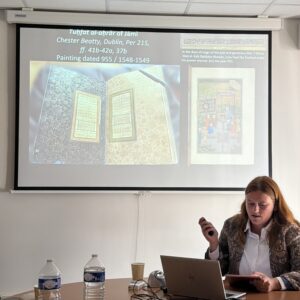
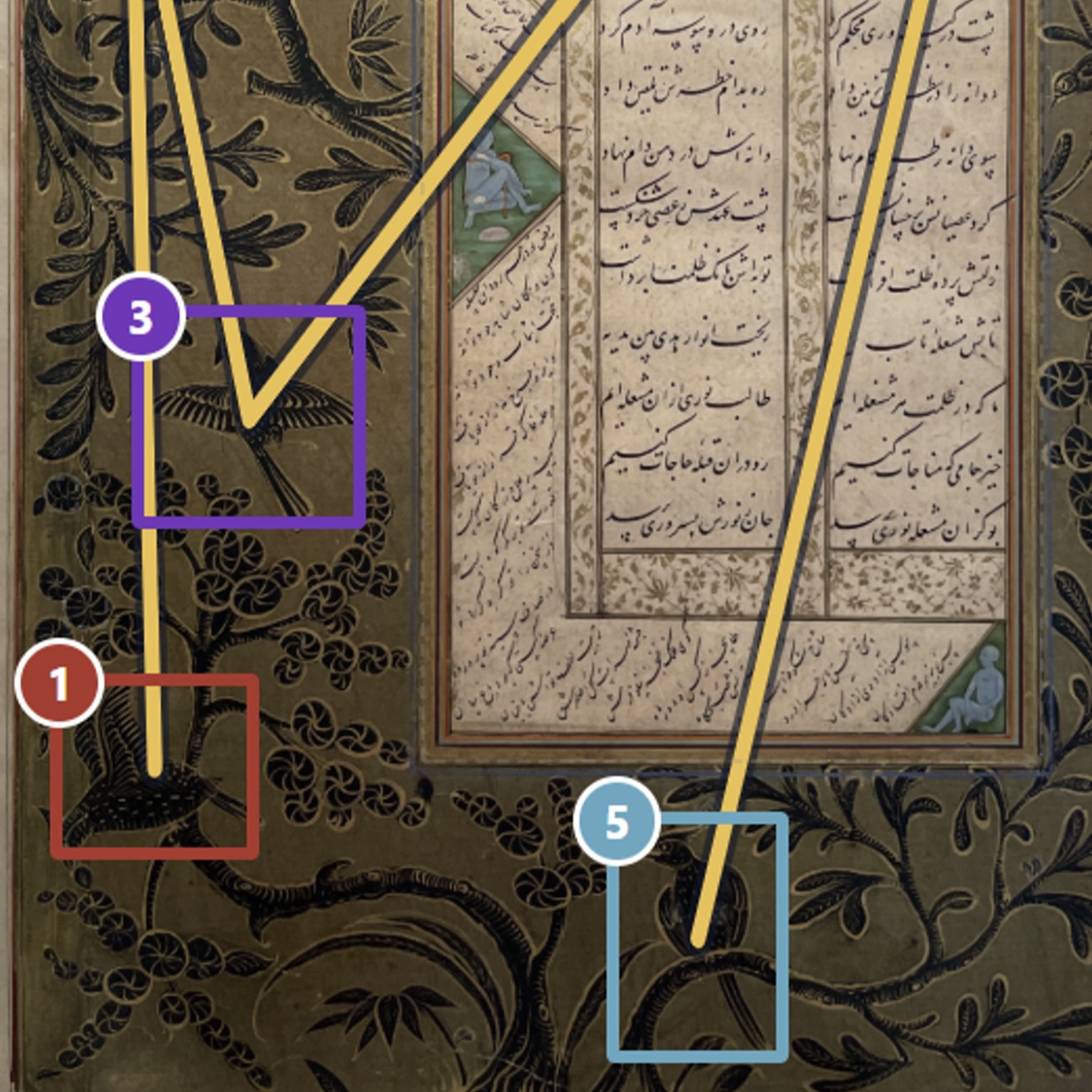
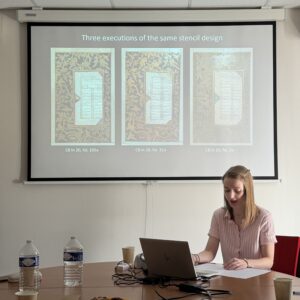
Our contribution presented manuscripts in which coloured stencilled designs appear across historically connected settings. We discussed how computational comparison might help us find related patterns in dispersed collections, while leaving questions of technique, dating and transmission open to examination of the objects themselves. The discussion brought valuable suggestions, including looking for comparable stencil practices in other media and investigating the movement of decorated papers and manuscripts between Bukhara, Khurasan and North India.
Nadia Ali returned to the problem of interpretation. How can we take historical context seriously without assuming that it yields only one possible reading of an image? This question matters when we compare similar designs: resemblance can suggest a connection, but it cannot on its own establish where a stencil was made or how a motif travelled. Her paper encouraged us to make our hypotheses, and the limits of their evidence, more visible.
The day closed with a discussion led by Eloïse Brac de la Perrière about broader directions for research on images in Islamic societies. We left Strasbourg with new questions for GLOBAL DECO PAPER: how might we study decorated paper as part of a manuscript’s visual thinking? How can we describe the changes a motif undergoes as it moves between objects and places? And how can digital tools reveal possible connections while keeping the material manuscript at the centre of interpretation?
The workshop gave us a productive setting in which to test these questions with colleagues working across different periods, media and methods. We thank Nourane Ben Azzouna for bringing us together and all the speakers for the conversations that will continue to inform our research.