
“Paper Matters” in Hamburg: Colour, Craft, and Connections across Eurasia (Day 1/3)
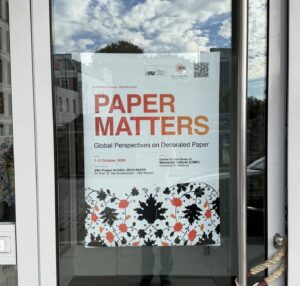
How do we study an almost invisible pattern? What can a tiny piece of coloured paper reveal about an album’s construction? How did decorated sheets move between workshops, courts, collectors, and readers? These questions brought us together at the Centre for the Study of Manuscript Cultures (CSMC), University of Hamburg, for “Paper Matters: Global Perspectives on Decorated Paper”. Across the opening two days, art historians, conservators, manuscript specialists, and practitioners explored how decorated paper connects artistic invention, technical knowledge, commerce, and the social lives of books.
30 September: An award for marbling research and tours of the lab
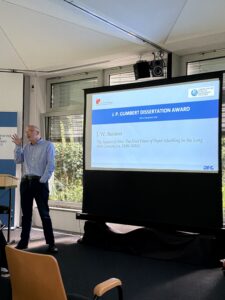
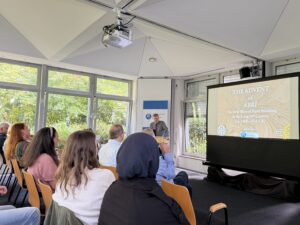
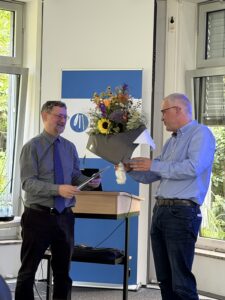
The J. P. Gumbert Dissertation Award ceremony provided a wonderful opening, honouring our affiliate researcher Dr Jake Benson for The Advent of Abri: The First Wave of Paper Marbling in the Long 16th Century (ca. 1496–1616). Prof Dr Konrad Hirschler introduced the award, followed by Prof Dr Tilman Seidensticker, who presented the dissertation and explained its selection. Jake’s lecture investigated when and where artists learned to float colours on liquids and transfer their designs onto paper, and how this knowledge spread. Drawing on Turco-Persian practitioners and an early Indo-Persian technical account, he connected marbling processes to the papers’ varied uses as coverings, margins, and writing surfaces. He distinguished informed transfer from partial knowledge, imitation, and innovation, while cautioning that the evidence did not establish an East Asian origin for abrī.
The afternoon also included tours of the CSMC Lab with Dr Sebastian Bosch and multispectral imaging technician Ivan Shevchuk. These gave us a closer look at the equipment and approaches used to investigate written artefacts, connecting our questions about decorated paper to the possibilities of scientific analysis. During the tours, we saw equipment for X-ray fluorescence (XRF), including Crono, and were introduced to Raman and Fourier-transform infrared (FTIR) spectroscopy. XRF provides information about the elements present in inks, pigments, and other materials, while Crono can map their distribution across selected areas. Raman and FTIR spectroscopy offer complementary information about material composition. Together, these complementary approaches can support the identification of colourants and other components of a decorated surface.
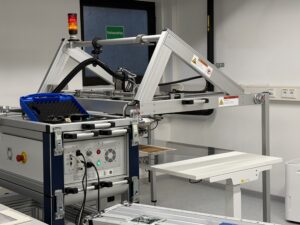
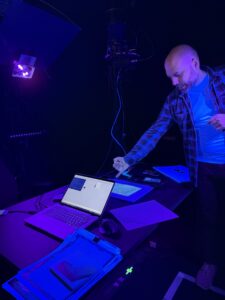
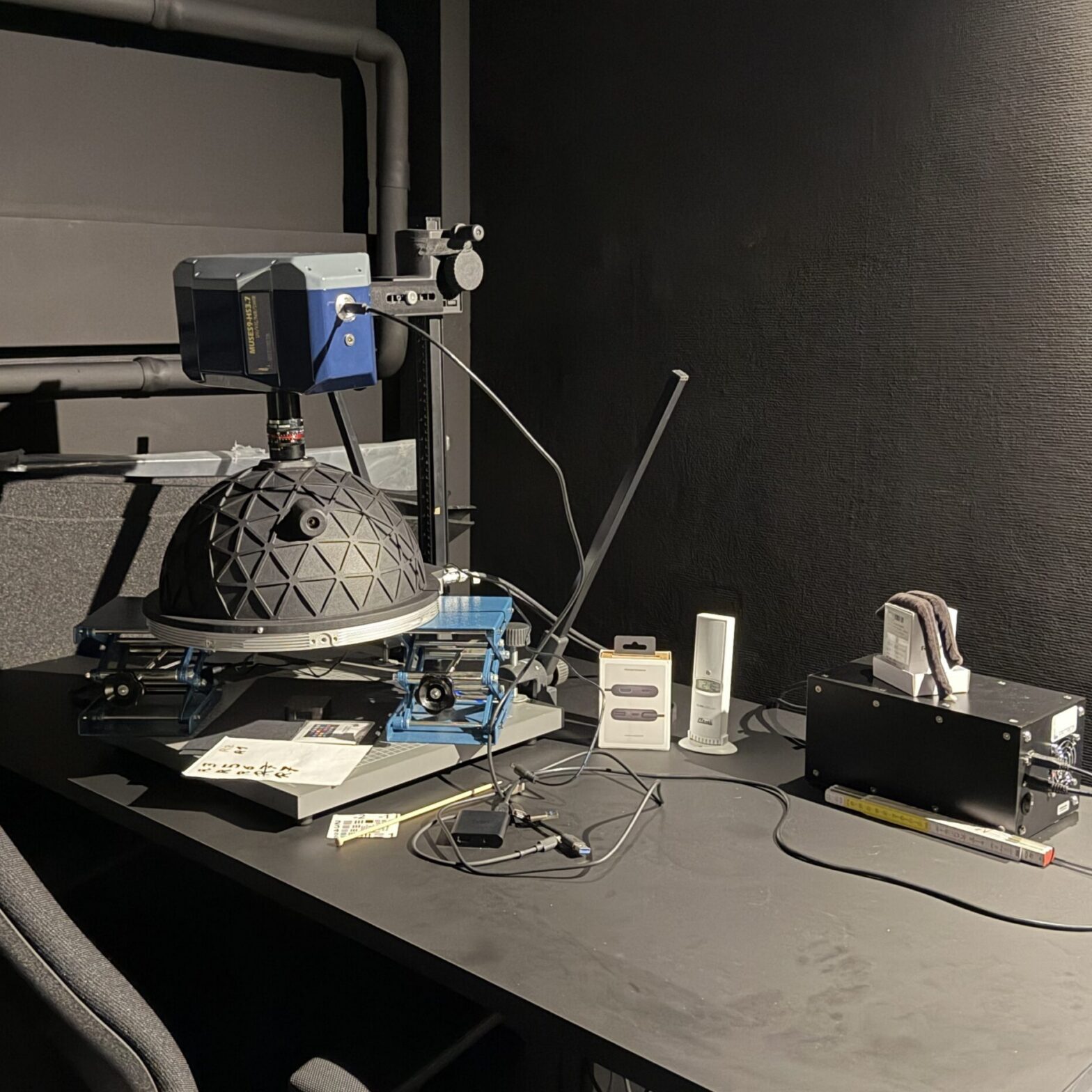
We also saw the multispectral imaging (MSI) setup, which offered another perspective on making the invisible visible. By recording an object at different wavelengths, it can enhance faded or obscured writing and reveal differences that ordinary photography does not capture. For our own research, these methods open possibilities for examining subtle decoration, distinguishing materials, and investigating alterations. Two points particularly stayed with us: the Mobile Lab’s emphasis on non-invasive investigation, and the portability of much of its equipment. Instruments can be packed and taken to libraries, archives, and museums, allowing analysis where the objects are kept. The tours provided a valuable introduction to methods whose possibilities – and limits – would recur throughout the workshop.
Stay tuned as we continue our account of the next two days, filled with lectures, discussions, and additional events exploring decorated paper across Eurasia!