

At the beginning of July, the GLOBAL DECO PAPER research team, comprising Ilse, Negar, Yih-chuen, and Theresa, travelled to Frankfurt for the 21st Colloquium of the Ernst Herzfeld Society. Four inspiring days lay ahead, beginning with the graduate meeting on the first day, which brought together a wide range of contributions by doctoral researchers. Although many papers focused on architecture, interesting parallels could already be drawn to decorated paper, particularly through questions of transmedial motifs, ornament, and material practices. Other recurring themes included decorative and epigraphic material, objects in context, and, to the team’s delight, the arts of the book. A paper on early Islamic parchment manufacture offered a particularly stimulating parallel to questions of paper production, the medium with which the GLOBAL DECO PAPER team is usually concerned.
The first day ended with a fascinating keynote lecture by Konrad Hirschler on the material turn and its potential to bridge disciplinary gaps within Islamic studies. Hirschler traced how Islamic and Arabic studies were, for much of the nineteenth and twentieth centuries, primarily shaped by philological approaches focused on texts. From the second half of the twentieth century onwards, however, a gradual reorientation took place: manuscripts, documents, and books came increasingly to be understood not only as carriers of texts, but also as physical objects with their own social, material, and historical significance. This shift has been strengthened by the so-called material turn, which foregrounds writing supports, pigments, inks, bindings, formats, book forms, and other material aspects of written artefacts. Hirschler highlighted the growing importance of archaeometric methods, such as optical and digital microscopy, multispectral imaging, infrared reflectography, XRF, CT, and other forms of scientific analysis. At the same time, he stressed that such approaches can only be fruitful when humanities scholars and natural scientists work closely together from the beginning. Without clearly formulated research questions and mutual understanding, scientific analysis risks becoming a “drop-off” service with limited interpretative value. Hirschler argued that the integration of material and scientific approaches offers an important opportunity not only for manuscript studies, but also for the future of the humanities more broadly.
The following reception proved to be an exciting networking event, with many stimulating conversations with international scholars working on a wide range of materials and regions.
The second day opened the main sequence of sessions, beginning with papers on particular groups of objects, from textiles and metalwork to stone masonry and stucco. In the afternoon, the focus shifted towards craftspeople and their techniques, including a paper on pouncing that was especially relevant to the GLOBAL DECO PAPER project. Further contributions addressed architecture, wall paintings, craftsmen’s representation at world fairs, and questions of provenance.
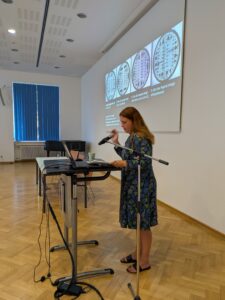

The third day began with several papers on manuscripts, focusing on scribal agency, image transfer, and the movement of motifs across media. This was followed by the GLOBAL DECO PAPER team’s own paper, “How Was It Made? Decorated Paper and Paper Decoration in the Islamicate World.” The presentation brought together four case studies from the fifteenth and sixteenth centuries. Ilse opened with different stages of paper decoration, including pouncing in illustration and hand-painted illumination. Yih-chuen then turned to zarafshān, or gold-sprinkled paper, and the importance of Chinese gold-flecked paper for the use, reception, and production of decorated paper in the eastern Islamic world. Theresa continued with stencilled paper, discussing stencils as carriers of artistic knowledge and as tools that reveal processes of reproducibility, mobility, and workshop practice. Negar concluded with Ottoman silhouette paper, explaining how it functioned technically, how it differs from stencilling, and how it could nevertheless produce related visual effects. Taken together, the four case studies showed that decorated paper in the Islamicate world was not merely a support for writing or painting, but the result of complex, carefully sequenced, and highly skilled artistic processes. Similar aesthetics could be achieved through different techniques, while decorated paper itself travelled widely through processes of reception, emulation, and adaptation. Stencilling, silhouetting, and pouncing enabled the reproducibility and portability of designs, while hand-painted decoration continued to play an important role. By asking not only what these decorated surfaces show, but how they were made, the paper offered new insights into workshop practices, artistic experimentation, and the mobility of techniques across regions.
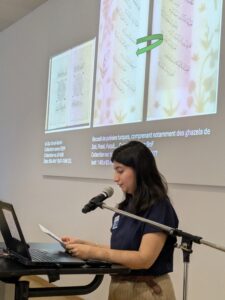
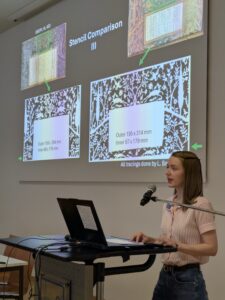
The team received generous feedback and many thought-provoking questions after the presentation. These addressed, among other topics, the role of primary sources and material evidence, the processes of papermaking, and the materials used for the tools involved in paper decoration. Further questions concerned what sizing agents may reveal about artisanal knowledge in different geographical contexts, and whether rice paste, as used in Japan, might also have functioned as a dyeing material.
The rest of the day continued with a wide range of materialities, including glass, mortar, and leather, once again demonstrating the breadth and richness of the EHG colloquium. The day ended with the annual assembly meeting.
On the fourth and final day, participants joined excursions to the collection of the Museum of Applied Arts, with a few pieces of the Islamic art collection, followed by a visit to the Archaeological Museum. The GLOBAL DECO PAPER team returned to Munich in the evening with many new ideas and impulses for future research.
We warmly thank the organisers, Hagit Nol and Mustafa Ahmad, for hosting us and for creating such an enjoyable and inspiring conference.